


It is 9am on a Tuesday. An invoice lands in a finance inbox, the sender looks right, the amount looks routine, and someone has about ninety seconds to decide before the wire goes out. That decision, made under pressure and on instinct, is what phishing training is really for. Not the certificate. The decision.
The short answer
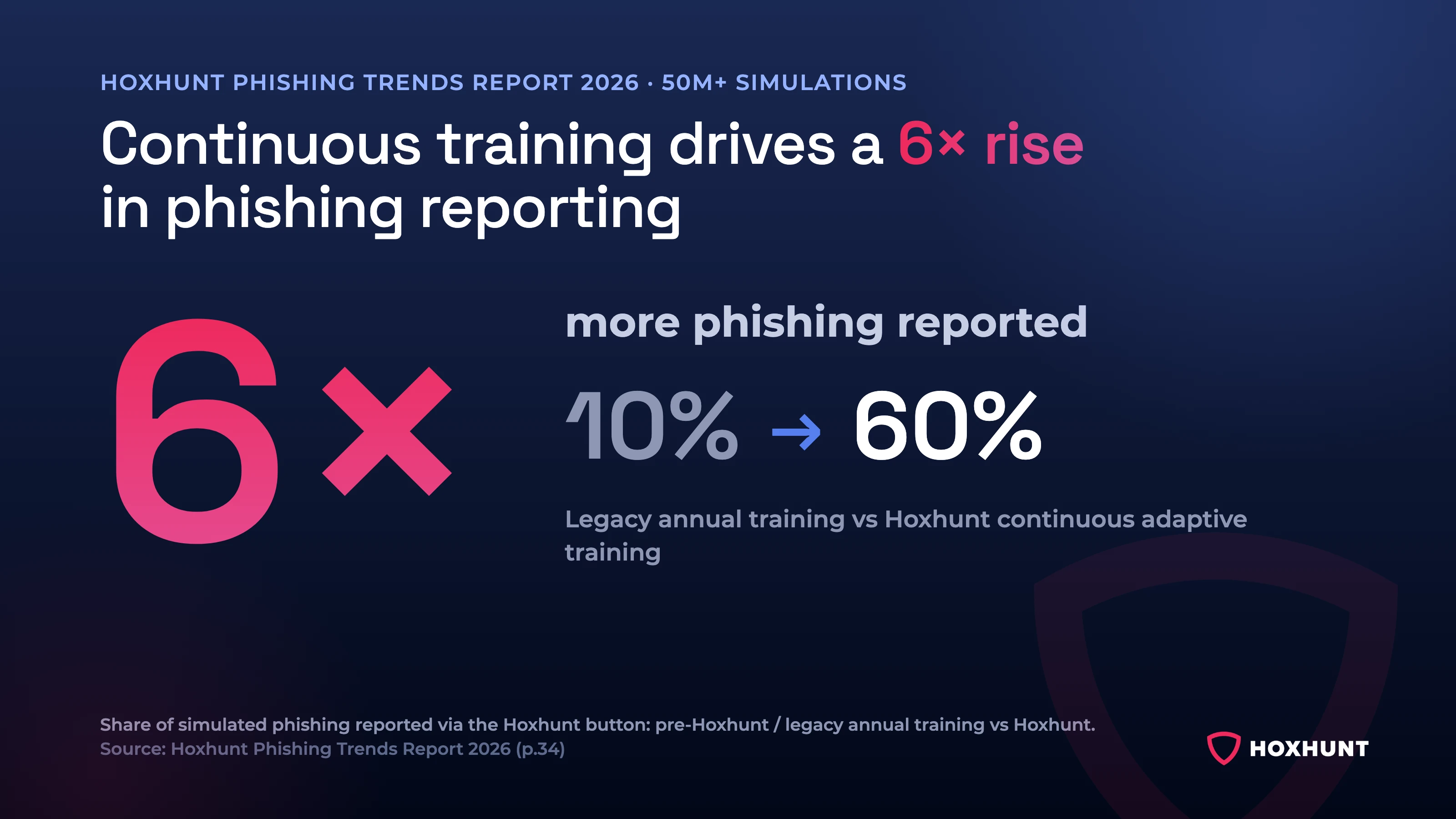
Phishing training teaches employees to recognize, resist, and report attacks through repeated, realistic practice rather than one annual course. It works when it's continuous and adaptive: across 50M+ simulations, reporting climbs roughly 6x, from about 10% to 60%, and the fastest 5% report a real threat in 39 seconds. The scoreboard isn't a completion certificate. It's whether reporting goes up and time-to-report goes down.
For the fuller view, see how to prevent phishing.What is phishing training?
Phishing training is the practice of preparing employees to spot and report phishing emails, texts, voice calls, and other social-engineering attempts before they cause a breach. It matters because people are the primary target: the human element is present in 60% of breaches (Verizon DBIR 2025), 80-95% of breaches start with a phishing attack (Comcast Business), and the average phishing breach costs about $4.88M (IBM 2025). Attackers now use AI to scale and personalize their lures, with AI-enabled phishing up 34% year over year (Verizon DBIR 2025). Training is the control that turns your largest attack surface, your people, into an active detection layer.
60%
of breaches involve the human element
Source: Verizon DBIR 2025
$4.88M
average cost of a phishing breach
Source: IBM Cost of a Data Breach 2025
Types of phishing attacks
Before your people can beat phishing, they need to know what it looks like now, and it no longer shows up only as a clumsy email. Attackers have spread across channels and dressed the bait in AI. These are the forms Hoxhunt sees most often in its threat data:
- Email phishing and impersonation. The core tactic. Microsoft, HR and supply-chain third parties are the most impersonated in Hoxhunt’s threat data.
- Spear phishing and business email compromise. Targeted lures, including fake reply-chains impersonating a CEO or finance team to authorize a payment.
- Deepfake phishing. AI-cloned voice and video of executives. See our guide to deepfake attacks.
- Vishing and callback phishing. Emails carrying a phone number instead of a link, to slip past filters and move the victim to a live call.
- Smishing. Phishing delivered by SMS and messaging apps.
- Quishing (QR-code phishing). Malicious QR codes, increasingly hidden inside attachments like PDFs to evade scanners.
- Adversary-in-the-middle. Kits that steal session tokens in real time and can bypass multi-factor authentication.
Hoxhunt’s Cyber Threat Intelligence Report details how each plays out in real campaigns.
Why most phishing training fails to reduce risk
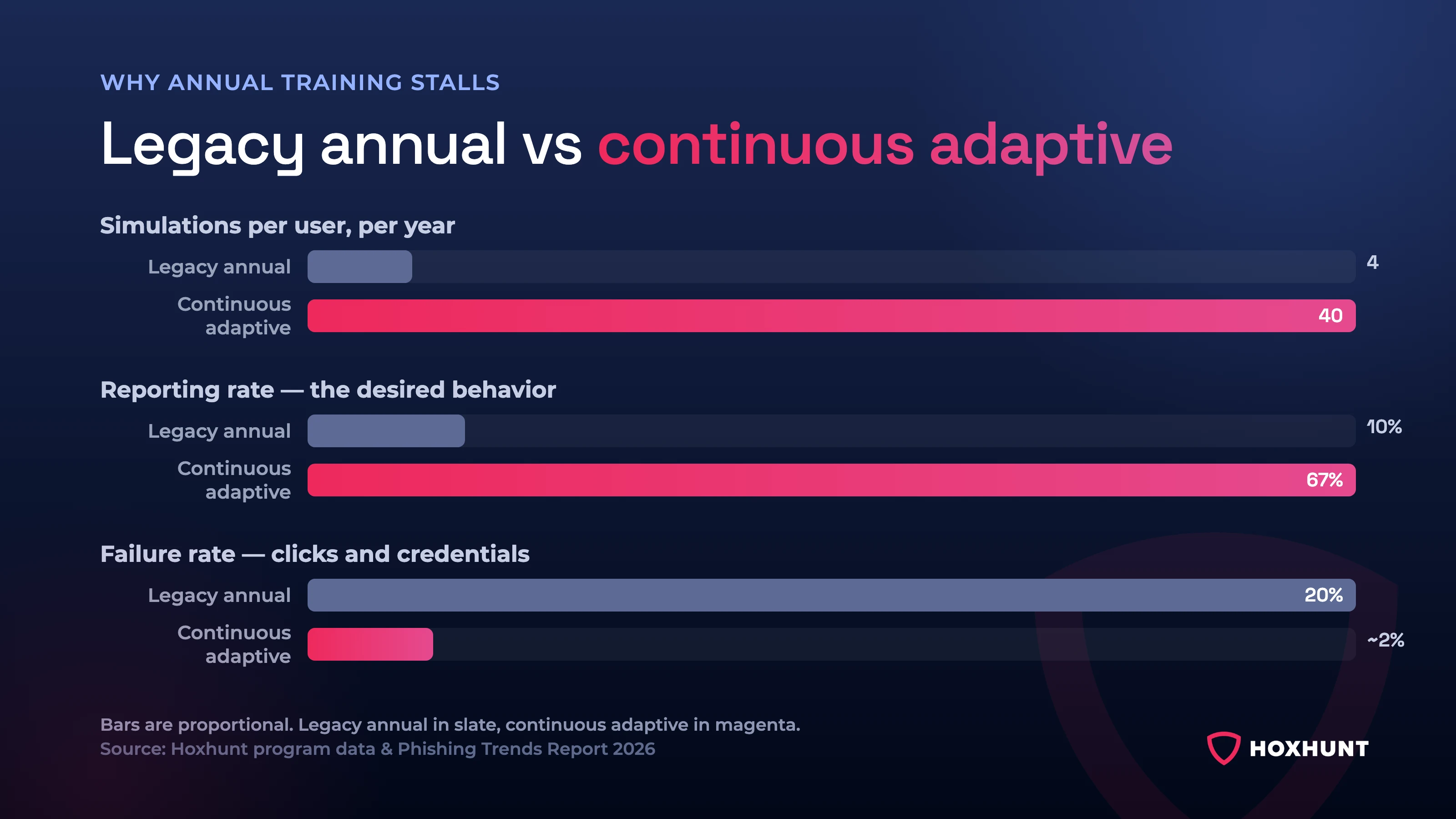
Here is the uncomfortable part: most phishing training is cramming, and cramming does not build skill. The typical annual or quarterly model runs about 4 simulated attacks per user per year and holds employees at roughly a 10% reporting rate that never improves. Hoxhunt baseline data on legacy-trained populations shows the pattern: about 10% report the threat, 20% fail, and 70% ignore it, and that split barely moves year over year (Hoxhunt Phishing Trends Report 2026).
Think about how anyone actually gets good at something under pressure. Athletes do not cram the night before; they run reps until the right move is muscle memory. A single annual course is the cram. Knowledge decays fast, 50-70% of new information is lost within days without repetition (the Ebbinghaus forgetting curve), so the lesson is gone long before the next real attack. The programs that reduce risk trade the annual event for continuous reps. That practice loop is the heart of security engagement training.
How to build a phishing training program that works
The best programs are built like a team, not a checklist: a system everyone buys into, run on repeat. Four steps, and the gap between a compliance program and a risk-reducing one shows up in each.
- Assess your baseline. Measure reporting rate, failure rate, and time-to-report before you train, and find your risk concentration. At Qualcomm, just 4% of users drove 80% of phishing incidents, so that is where the game plan starts.
- Choose continuous, adaptive reps. Move from about 4 simulations per user per year to roughly 40, with difficulty that rises as skill rises. Adaptive difficulty is what stops the year-one plateau.
- Build a system people buy into. Gamified, personalized programs earn participation instead of resentment. Port of Antwerp-Bruges lifted awareness past 90% and held it for over a year, after a legacy tool decayed from 90% to 50%.
- Run the loop: train, simulate, measure, refine. Feed real reported threats and current attack patterns back into simulations so training reflects what is actually hitting inboxes.
How to measure phishing training effectiveness
The scoreboard is behavioral, not completion-based. Track three numbers against simulations that get harder over time: reporting rate (who flags a simulation with a one-click button), failure rate (who clicks or hands over credentials), and time-to-report (how fast the first report reaches the SOC, your leading indicator of resilience). Completion rates tell you who showed up; these tell you whether risk is actually dropping.
39s
the fastest 5% report a real threat
Source: Hoxhunt Phishing Trends Report 2026
9x
rise in real-threat reporting
Source: Hoxhunt program data
What results to expect
Effective phishing training produces measurable, durable drops in human risk, and the proof is in customer outcomes across regions. Across the Hoxhunt base, malicious clicks fall by roughly 86% and real-threat reporting rises 9x.
This connects to whether awareness training works.United States
Qualcomm
~48,000 employees, semiconductors
- 6X improvement in measurable resilience
- 4% of users drove 80% of incidents
- ~half the failure rate after targeting risk
Europe
Swisscom
~23,000 employees, telecoms (Switzerland)
- 15% to <2% failure rate (10x reduction)
- 85% simulation reporting rate
- <1 mo to full implementation
Benefits of phishing training for employees
This is where the reps pay off. Done well, phishing training moves the numbers a security leader actually answers for, not just the headcount that finished a course. Across Hoxhunt’s programs:
- Fewer people fall for attacks. Failure rates drop toward 2% and malicious clicks fall by roughly 86%.
- More threats get reported. Simulated-threat reporting rises 6x, from 10% to 60%, turning employees into an early-warning system.
- Faster real-threat detection. Real-threat reporting rises up to 9x, so security teams see live attacks sooner.
- Measurable, board-ready risk reduction. Reporting rate, time-to-report and failure rate show whether risk is actually falling.
- Compliance coverage. Continuous training helps satisfy frameworks like ISO 27001, SOC 2, HIPAA, DORA and NIS2.
Source: Hoxhunt Phishing Trends Report 2026 (50M+ simulations).
Phishing training vs security awareness training
Phishing training and security awareness training are related but not the same. Phishing training is focused practice against phishing and social engineering, the single largest breach vector, measured by reporting and failure rates. Security awareness training is the broader program covering passwords, data handling, and compliance alongside phishing. The strongest programs treat phishing training as the high-frequency behavioral core inside a wider awareness strategy. If you are evaluating full platforms, see our guide to the best security awareness training.
| Dimension | Phishing training | Security awareness training |
|---|---|---|
| Focus | Behavioral practice against phishing and social engineering | Broad curriculum across all security topics |
| Format | Continuous simulations plus in-the-moment lessons | Courses, modules, and videos |
| Frequency | Continuous (around weekly micro-simulations) | Periodic or annual |
| What it measures | Reporting rate, time-to-report, failure rate | Course completion and quiz scores |
| Behavior change | High: reps build the reporting habit (10% to 60%, a 6x rise) | Low on its own, because knowledge decays within days |
| Role | The highest-frequency, highest-impact component | The umbrella program that contains it |
How to choose phishing training tools
Choosing a phishing training tool comes down to whether it changes behavior at scale, not how many templates it ships. Look for continuous adaptive simulations, one-click reporting that feeds your SOC, personalization by role and risk, realistic and current threat content, and measurement built around reporting rate and time-to-report. For a vendor-neutral breakdown of simulation platforms, see our best phishing simulation tools guide, and the human risk management playbook for how continuous training reduces risk end to end.
Frequently asked questions
Why is phishing training important?
Because people are the most-targeted attack surface: the human element is in 60% of breaches and 80-95% of breaches begin with phishing (Verizon DBIR 2025, Comcast Business). Training converts that surface into a detection layer.
What makes phishing training effective?
Continuity and adaptivity. Effective programs run continuous personalized simulations with rising difficulty, and measure reporting rate and time-to-report, not course completion.
How often should you conduct phishing training?
Continuously. Leading programs run roughly 40 short simulations per user per year rather than 4, because knowledge decays within days and one annual event is forgotten before the next real attack (Hoxhunt Phishing Trends Report 2026).
How does phishing training differ from security awareness training?
Phishing training is focused behavioral practice against phishing and social engineering; security awareness training is the broader curriculum. Phishing training is usually the highest-frequency, highest-impact component inside it.
What results can I expect?
Trained organizations typically see failure rates fall toward 2% and reporting rates rise past 60%, with results like Qualcomm 6X resilience and Swisscom 15% to under 2% (Hoxhunt Phishing Trends Report 2026 and customer data).
How do you implement a phishing training program?
Start with a baseline simulation to measure your current reporting and failure rates, then roll out with SSO or SCIM to a first cohort and run continuous simulations that adapt difficulty by role and risk. Users onboard in about a minute, and the first eight weeks are the ramp where the habit forms.
How much does phishing training cost?
Enterprise phishing training is usually priced per user per year and varies by organization size, features, and integrations. The number that matters is cost per outcome: a program that raises reporting rate and lowers failure rate reduces breach risk, which is where the return sits.
Does phishing training actually work?
Yes, when it is continuous and adaptive. Across more than 50 million simulations, reporting rose 6x from 10% to 60% compared with legacy annual training, and trained organizations typically drive failure rates toward 2% (Hoxhunt Phishing Trends Report 2026). A once-a-year course does not change behavior, because knowledge decays within days.
How do you train employees against AI and deepfake phishing?
Use simulations built on real, current attack patterns, including AI-generated lures, deepfake voice, and multichannel scenarios across email, SMS, and voice. Raise difficulty as users improve so the training keeps pace with attackers who are also using AI. For the specifics, see our guide to deepfake phishing training.
What should you do with employees who keep failing phishing tests?
Avoid punishing them. Repeat clicks concentrate risk in specific cohorts, so route those users into higher-frequency adaptive practice with in-the-moment coaching, so they get more reps on the behavior rather than a single remedial course.
Is phishing training required for compliance?
Many frameworks require security awareness and phishing training, including ISO/IEC 27001, SOC 2, PCI DSS, HIPAA, DORA, and NIS2. Continuous phishing training satisfies the requirement and also produces the behavior-change evidence that auditors and boards increasingly ask for.
Evidence: Hoxhunt Phishing Trends Report 2026 (50M+ simulations, 4M+ users, 125 countries); Hoxhunt program data; Verizon DBIR 2025; IBM Cost of a Data Breach 2025; Comcast Business. Case studies: Qualcomm (US), Swisscom (EU), Port of Antwerp-Bruges (EU).
Get more cybersecurity insights like this
- Subscribe to All Things Human Risk to get a monthly round up of our latest content
- Request a demo for a customized walkthrough of Hoxhunt
.webp)
.avif)