


FEATURED
Level up your Security Awareness Training Program via Gamification

July 1, 2026

Multiple sessions
The leading authority on game design, Yu-kai Chou, connects with Hoxhunt's VP of Human Risk, Maxime Cartier for practical insights into applying gamification to level-up security awareness engagement.

Yu-kai Chou
Author, Speaker, and Gamification Pioneer

Maxime Cartier
VP of Human Risk Management at Hoxhunt
Watch the video
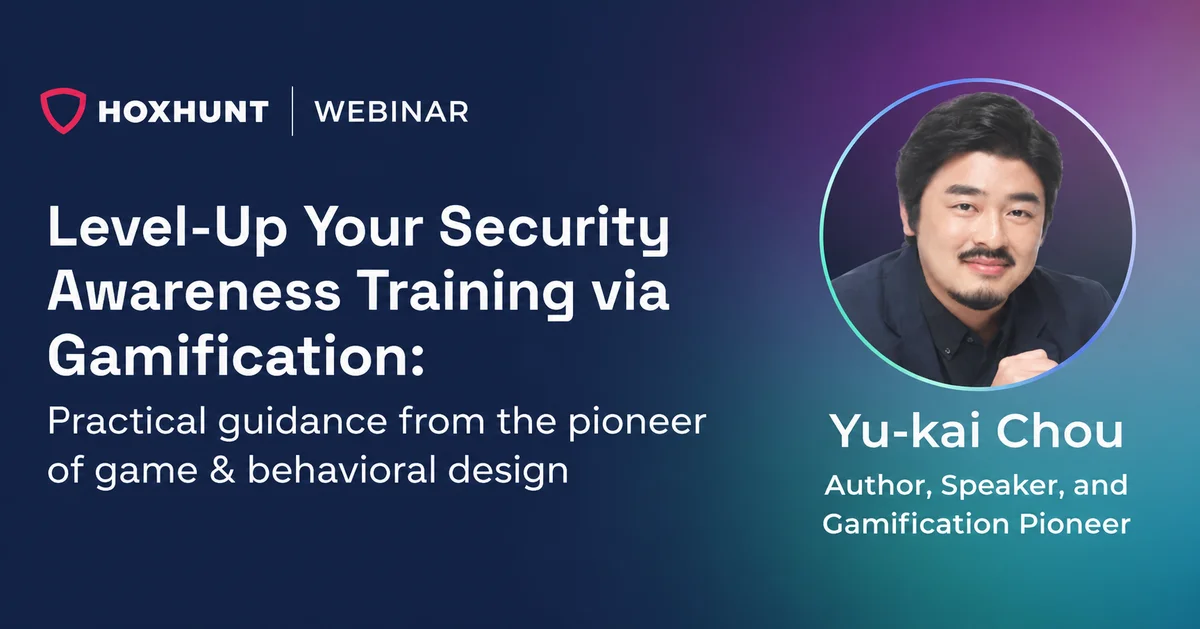

Practical insights from the pioneer of game and behavioral design
Most security awareness programs struggle with the same challenge:
How do you create lasting security habits when employees don't want more training?
On June 30, join world-renowned gamification pioneer, Yu-kai Chou and Hoxhunt VP of Human Risk, Maxime Cartier for a deep dive into the applied psychology of engagement, motivation, and behavior change.
Yu-kai's Octalysis Framework has influenced products and engagement systems used by more than 1.5 billion people worldwide and has shaped the design philosophy behind organizations including Google, Microsoft, LEGO, Salesforce, and Hoxhunt.
Together, Yu-kai and Maxime will explore how the same behavioral principles that keep people engaged in games for years can be applied to cybersecurity awareness training, phishing simulations, and human risk management programs.
What You'll Learn
Succeed where some gamification programs fail
Discover why points, badges, and leaderboards alone rarely create lasting behavior change and what actually drives long-term engagement.
The psychology behind effective security behavior
Learn how intrinsic motivation outperforms rewards, and why making training enjoyable is more effective than simply making it mandatory.
How to balance urgency without creating burnout
Security programs often rely on fear, loss, and consequences. Learn how to combine these tactics with positive motivators that build sustainable security habits.
Why engagement is the leading indicator of security outcomes
Explore how exposure, participation, and ongoing interaction drive stronger reporting behavior and better security performance over time.
The most underutilized game mechanics in cybersecurity
Learn how creativity, storytelling, teamwork, scenario-based learning, and meaningful choice can dramatically improve engagement and retention.
How to maintain engagement year after year
What separates programs that lose momentum after a few months from experiences that keep users engaged for years?
Debunking the biggest myths about gamification
- "Gamification only works for younger employees"
- "Our organization is too serious for gamification"
- "Rewards attract the wrong people"
- "Employees eventually get bored"
Building security habits that become instinctive
Discover how the best programs move beyond compliance and create muscle memory that helps employees make safer decisions naturally.
Why Attend?
This isn't a theoretical discussion. You'll hear practical examples from real-world cybersecurity programs, behavioral science research, and game design principles that have influenced engagement systems used by millions of people worldwide.
Whether you're leading security awareness, human risk management, security culture, or behavior change initiatives, you'll leave with actionable insights you can apply immediately.
Check out Yu-kai's books on gamification for your program, and for your personal development

Speakers
Yu-kai Chou
Author, Speaker, and Gamification Pioneer

Yu-kai Chou is an Author and International Keynote Speaker on Gamification and Behavioral Design. He is the Founding Partner and Chief Creation Officer of the premium consulting/design firm The Octalysis Group, as well as Co-Founder and Chief Experience of Metablox - an NFT platform powered by Real World Places and Real Life Memories.
Maxime Cartier
VP of Human Risk Management at Hoxhunt
Maxime is one of the world's leading voices in Human Risk Management and Cybersecurity Behavior Change. He works with organizations worldwide to transform security awareness from a compliance exercise into measurable risk reduction through behavioral science and engagement.
Subscribe to All Things Human Risk
Subscribe to our newsletter for a curated digest of the latest news, articles, and resources on human risk and the ever-changing landscape of phishing threats.
FEATURED
Level up your Security Awareness Training Program via Gamification
The leading authority on game design, Yu-kai Chou, connects with Hoxhunt's VP of Human Risk, Maxime Cartier for practical insights into applying gamification to level-up security awareness engagement.
Practical insights from the pioneer of game and behavioral design
Most security awareness programs struggle with the same challenge:
How do you create lasting security habits when employees don't want more training?
On June 30, join world-renowned gamification pioneer, Yu-kai Chou and Hoxhunt VP of Human Risk, Maxime Cartier for a deep dive into the applied psychology of engagement, motivation, and behavior change.
Yu-kai's Octalysis Framework has influenced products and engagement systems used by more than 1.5 billion people worldwide and has shaped the design philosophy behind organizations including Google, Microsoft, LEGO, Salesforce, and Hoxhunt.
Together, Yu-kai and Maxime will explore how the same behavioral principles that keep people engaged in games for years can be applied to cybersecurity awareness training, phishing simulations, and human risk management programs.
What You'll Learn
Succeed where some gamification programs fail
Discover why points, badges, and leaderboards alone rarely create lasting behavior change and what actually drives long-term engagement.
The psychology behind effective security behavior
Learn how intrinsic motivation outperforms rewards, and why making training enjoyable is more effective than simply making it mandatory.
How to balance urgency without creating burnout
Security programs often rely on fear, loss, and consequences. Learn how to combine these tactics with positive motivators that build sustainable security habits.
Why engagement is the leading indicator of security outcomes
Explore how exposure, participation, and ongoing interaction drive stronger reporting behavior and better security performance over time.
The most underutilized game mechanics in cybersecurity
Learn how creativity, storytelling, teamwork, scenario-based learning, and meaningful choice can dramatically improve engagement and retention.
How to maintain engagement year after year
What separates programs that lose momentum after a few months from experiences that keep users engaged for years?
Debunking the biggest myths about gamification
- "Gamification only works for younger employees"
- "Our organization is too serious for gamification"
- "Rewards attract the wrong people"
- "Employees eventually get bored"
Building security habits that become instinctive
Discover how the best programs move beyond compliance and create muscle memory that helps employees make safer decisions naturally.
Why Attend?
This isn't a theoretical discussion. You'll hear practical examples from real-world cybersecurity programs, behavioral science research, and game design principles that have influenced engagement systems used by millions of people worldwide.
Whether you're leading security awareness, human risk management, security culture, or behavior change initiatives, you'll leave with actionable insights you can apply immediately.
Check out Yu-kai's books on gamification for your program, and for your personal development
Speakers
Yu-kai Chou
Author, Speaker, and Gamification Pioneer
Yu-kai Chou is an Author and International Keynote Speaker on Gamification and Behavioral Design. He is the Founding Partner and Chief Creation Officer of the premium consulting/design firm The Octalysis Group, as well as Co-Founder and Chief Experience of Metablox - an NFT platform powered by Real World Places and Real Life Memories.
Maxime Cartier
VP of Human Risk Management at Hoxhunt
Maxime is one of the world's leading voices in Human Risk Management and Cybersecurity Behavior Change. He works with organizations worldwide to transform security awareness from a compliance exercise into measurable risk reduction through behavioral science and engagement.


.webp)