


THE SHORT ANSWER
Hoxhunt is the highest-rated security awareness training platform for enterprises on G2: #1 on G2's Highest-Rated Security Awareness Training Software for Enterprise list with a satisfaction score of 100 out of 100, and 4.8/5 across 3,733 reviews (October 2026). The right pick still depends on what you need: KnowBe4 for a large ready-made content library, Proofpoint ZenGuide or Cofense if you already run their email security, and MetaCompliance for pairing awareness with policy management.
If you’re shortlisting security awareness training, the hard part is telling which platforms change what employees do and which ones mostly generate compliance reports. Here at Hoxhunt, we’ve sat on the vendor side of a lot of those shortlists. We know which questions get asked, and which ones should be. Below, we compare the eight platforms enterprises evaluate most in 2026 on the dimensions that move real risk, then show where each one fits. It’s written for security leaders and the people who run awareness and human risk programs, whether you’re buying for the first time, replacing a platform or reviewing one at renewal.
Key takeaways
- What it is. Security awareness training teaches employees to recognize and report phishing and other social engineering. In 2026 the buying question is whether a platform changes what people do, and whether it can prove it with reporting data.
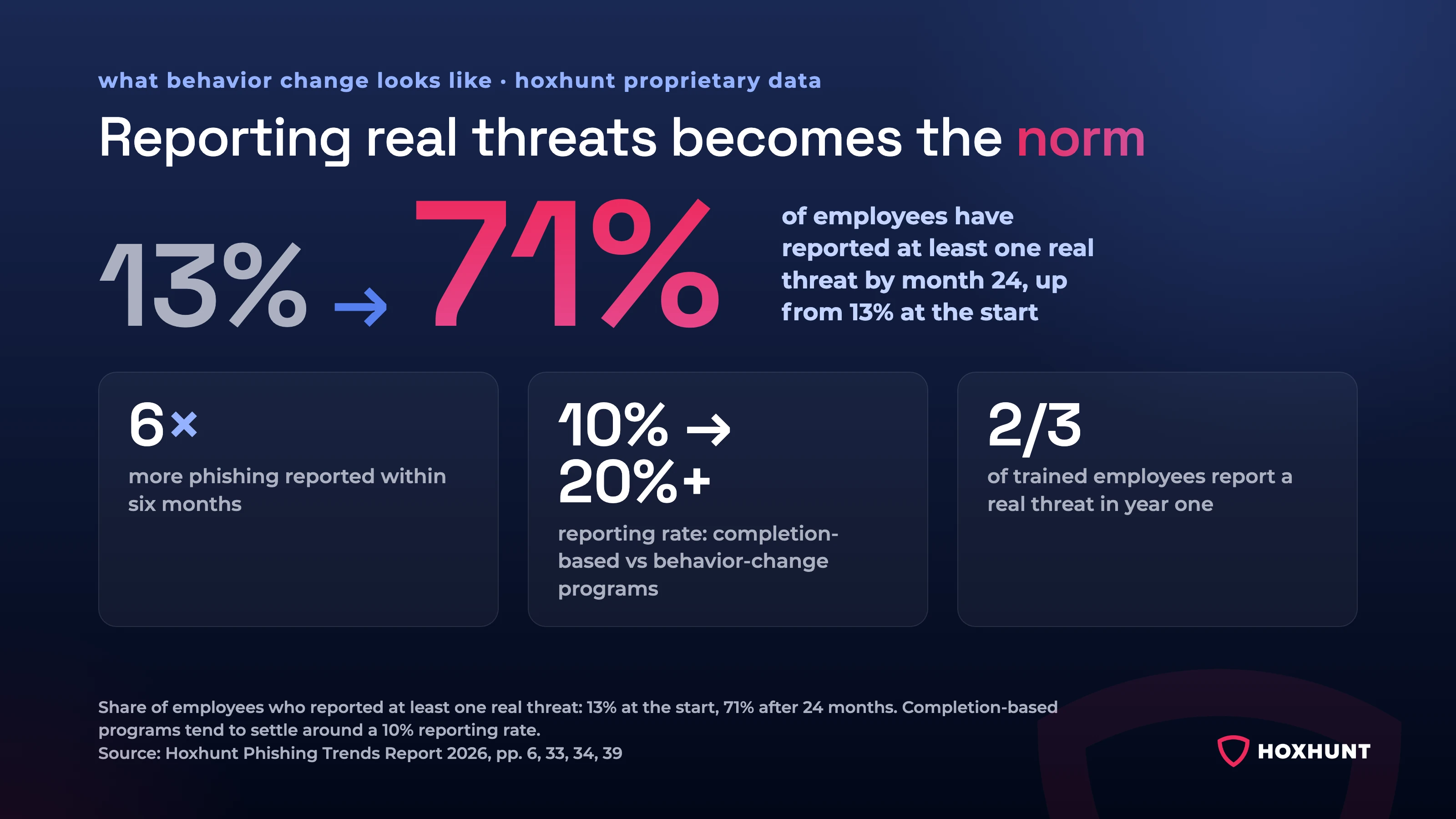
- What it changes. Across Hoxhunt customers, the share of employees who have reported at least one real threat rises from 13% at the start to 71% after 24 months (Hoxhunt Phishing Trends Report 2026, p.39).
- Who fits what. Hoxhunt is best for enterprise behavior change across the whole workforce. KnowBe4 is best for a large ready-made content library. Proofpoint ZenGuide and Cofense fit organizations already on their email security, and MetaCompliance is best for pairing awareness with policy management.
- Beyond email. Attacks now arrive by phone, video call, chat and text: 5% of AI-generated phishing emails in 2025 carried a malicious phone number for the victim to call (Hoxhunt Phishing Trends Report 2026, p.7). Hoxhunt simulates voice, deepfake video, Microsoft Teams and SMS attacks.
- Pricing. Only KnowBe4, SoSafe and Huntress publish list prices. Everyone else, Hoxhunt included, quotes on request. Compare quotes as total cost per year for your headcount, including add-ons and admin time.
- Compliance. NIST SP 800-50 Rev. 1 is the public yardstick for how a program should be run and measured. HIPAA, PCI DSS, ISO 27001, GDPR and SOC 2 all ask for recurring training with per-person evidence.
What to look for in security awareness training in 2026
Human error still drives most incidents. The human element is involved in 62% of breaches, according to the Verizon DBIR 2026 (full disclosure: Hoxhunt is one of the report's data contributors). For a large, distributed workforce, the selection criteria have moved on from course-library size. What matters now is measurable behavior change, phishing resilience on every channel attackers use, and coverage of the whole workforce, including the people who don’t have a corporate login.
Here is what to evaluate, what good looks like, and how to validate each in a demo or pilot:
| Evaluation question | What good looks like | What to validate in a demo or pilot |
|---|---|---|
| Does it change behavior, or only track completion? | Measures click-rate trends, reporting rates and repeat failures; reinforces with microlearning right after a real action | Ask for before and after examples (60 to 90 days) from the platform's own reporting; check whether completion is a primary KPI |
| How do we measure effectiveness, including the people who never respond? | Baseline and post-rollout benchmarking; segmentation by role, team, region and risk tier; shows who reports, who clicks and who ignores | Confirm you can export the metrics stakeholders use; ask how risk scoring is calculated |
| Does the threat content cover the channels attackers use now? | Simulations across email, SMS (smishing), voice (vishing and callback), Microsoft Teams and deepfake video; QR lures and MFA-fatigue scenarios; refresh cadence tied to real campaigns | Ask which channels ship today versus on the roadmap, how often content updates, and for recent scenario examples |
| Can it tailor to roles and risk levels? | Role-based paths (finance, HR, legal, execs, IT); risk-tier targeting; per-person difficulty | Confirm how roles are defined and how your policies and workflows are embedded |
| Does it cover your whole workforce? | Reaches frontline staff, contractors and the board who have no corporate login (via link, QR or SCORM) as well as desk-based employees | Ask how non-account users are enrolled and tracked, and how many languages simulations and training support |
| Is reporting frictionless, and does it feed response? | One-click report button; immediate feedback; clear routing from the employee report into incident response, for Teams messages as well as email | Follow the end-user flow in Outlook or Gmail; confirm what employees see after reporting and where the report goes |
| Is it usable at scale, and does it fit your stack? | Automation for scheduling, grouping and reporting; low steady-state overhead; Microsoft 365 or Google Workspace; single sign-on and SCIM provisioning from your identity provider; HR attributes (department, site, role) for targeting; SCORM for your LMS | Have admins run a real workflow; validate deliverability and allowlisting; confirm which identity providers and HR attributes are supported |
| Will it satisfy an auditor? | Per-person completion and simulation records with dates, exportable; policy acknowledgement where your framework asks for it; data residency and retention you can state | Export one person's full training record during the demo and read it as an auditor would |
| What support and onboarding is included? | Implementation help; program design (cadence, KPIs, comms); ongoing optimization | Ask about onboarding timeline and CSM cadence |
Two public references give you a neutral yardstick for the table above. NIST SP 800-50 Rev. 1, Building a Cybersecurity and Privacy Learning Program (September 2024), is the current federal guidance on how to plan, run and measure an awareness and training program. It treats the work as a continuing program rather than an annual course. CISA’s phishing guidance covers what every employee should be able to do: recognize a phishing attempt and report it.
A note on size: we wrote this for mid-to-large organizations. If you’re a small team without a dedicated security admin, start with the managed options further down. Huntress sells direct from 50 learners, and KnowBe4’s published price bands start at 25 seats.
Vishing, deepfake and multi-channel attacks: what to check in a platform
Phishing no longer stays in the inbox. In our analysis of 2025 attacks, 5% of AI-generated phishing emails included a malicious phone number. That number is the opening move of a callback phishing campaign, where the victim dials the attacker (Hoxhunt Phishing Trends Report 2026, p.7). Voice clones, deepfake video calls and fake Teams messages follow the same logic: move the victim to a channel where the email filter and the pause-and-reread habit don’t help. A platform that only ever sends simulated emails is training people for part of the problem.
What good looks like. Simulations that arrive the way real attacks do: a phone call or a number to call back, a video meeting with a cloned face and voice, a Teams message, a text message, a QR code. Lessons that rehearse live pressure on a call, so people get their reps in at verifying and escalating before an attacker tests them for real. A way to report from each channel into the same response queue as reported email, and follow-up training after every outcome. Our guides to vishing attacks and deepfake attacks show how each attack unfolds.
How to validate it in a pilot. Ask each vendor to run one simulation per channel to a small group, with you on the receiving end. Check whether the scenario is specific to your organization (your helpdesk name, your meeting tool). Watch what the employee sees in the ten seconds after they report or comply, and whether the result lands in the same dashboard as the email simulations. Then ask which channels are in the quote and which are separate engagements.
Where Hoxhunt stands. Hoxhunt simulations span email, smishing, vishing and callback, Microsoft Teams, and deepfake video (Hoxhunt phishing training). For voice, we ship three options. The first is browser-based voice phishing lessons, where the employee talks to an AI voice agent, and these are included in the security awareness training product. The second is callback phishing simulations, where the email carries a phone number and calling it connects to an AI voice agent running a scripted pretext. The third is simulated vishing calls to the number on the employee’s profile from a local number, where handing over information is the fail condition and every outcome gets a follow-up lesson. For deepfakes, generic simulations in the standard library use avatars impersonating trusted roles such as IT support. Custom deepfake attacks, built and delivered by Hoxhunt, clone an executive’s likeness and voice with their consent inside a browser-based look-alike of Teams, Google Meet or Zoom. Teams simulations are reported with the native Microsoft report button, and reported Teams threats reach the security team’s queue alongside email. Smishing campaigns are a separate service delivered by our team. We haven’t published outcome figures for the deepfake and voice modules yet, so ask for them in your pilot as you would of any vendor.
How we evaluated these platforms
Rankings draw on 9,300+ verified G2 reviews (October 2026), cross-checked against user feedback on Gartner Peer Insights, Capterra and TrustRadius (listed in Sources). We weighted them toward evidence of measurable behavior change over feature counts. Vendor facts, channels and prices come from each vendor’s own product and pricing pages, and the G2 figures from G2’s API, both read in October 2026, so you can check every figure yourself. Hoxhunt was named a Gartner Peer Insights Customers’ Choice for Security Awareness Computer-Based Training in 2024. Where we describe Hoxhunt, we use our own product documentation and published customer cases, and we say so.
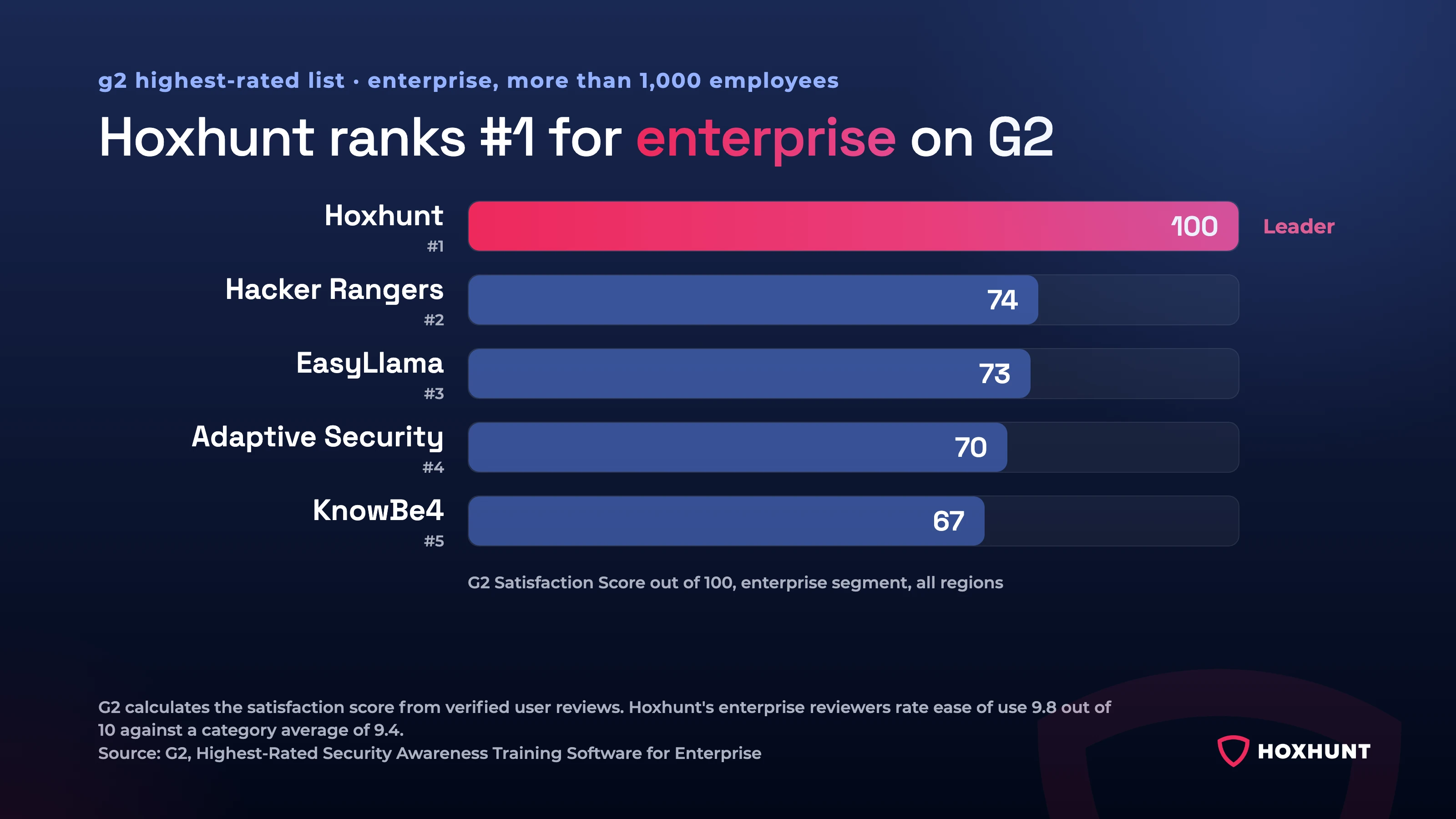
Hoxhunt is the highest-rated security awareness training platform for enterprises on G2. On G2's Highest-Rated Security Awareness Training Software for Enterprise list (organizations with more than 1,000 employees, all regions, October 2026), Hoxhunt ranks #1 with a G2 Satisfaction Score of 100 out of 100, ahead of Hacker Rangers (74), EasyLlama (73), Adaptive Security (70) and KnowBe4 (67). Hoxhunt also ranks #1 on the same list filtered to North America (99), Europe (98) and Asia (92).
Enterprise reviewers score Hoxhunt above the category average on ease of use (9.8 vs 9.4 out of 10), ease of setup (9.7 vs 9.2), meeting requirements (9.7 vs 9.4) and ease of admin (9.6 vs 9.3).
| Rank | Platform | Score |
|---|---|---|
| 1 | Hoxhunt | 100 |
| 2 | Hacker Rangers | 74 |
| 3 | EasyLlama | 73 |
| 4 | Adaptive Security | 70 |
| 5 | KnowBe4 | 67 |
Security awareness training platforms and vendors compared (2026)
Each row sums up one platform. “Fits when” names the use case, and “Strengths” lists what reviewers cite. “Channels covered” lists only the simulation channels the vendor states on its own site. “Trade-offs to validate” is what goes on your pilot plan. Start with “Fits when” and read it against your own stack and your renewal date.
| Platform | Fits when | Strengths (what reviewers cite) | Channels covered (vendor-stated) | Trade-offs to validate |
|---|---|---|---|---|
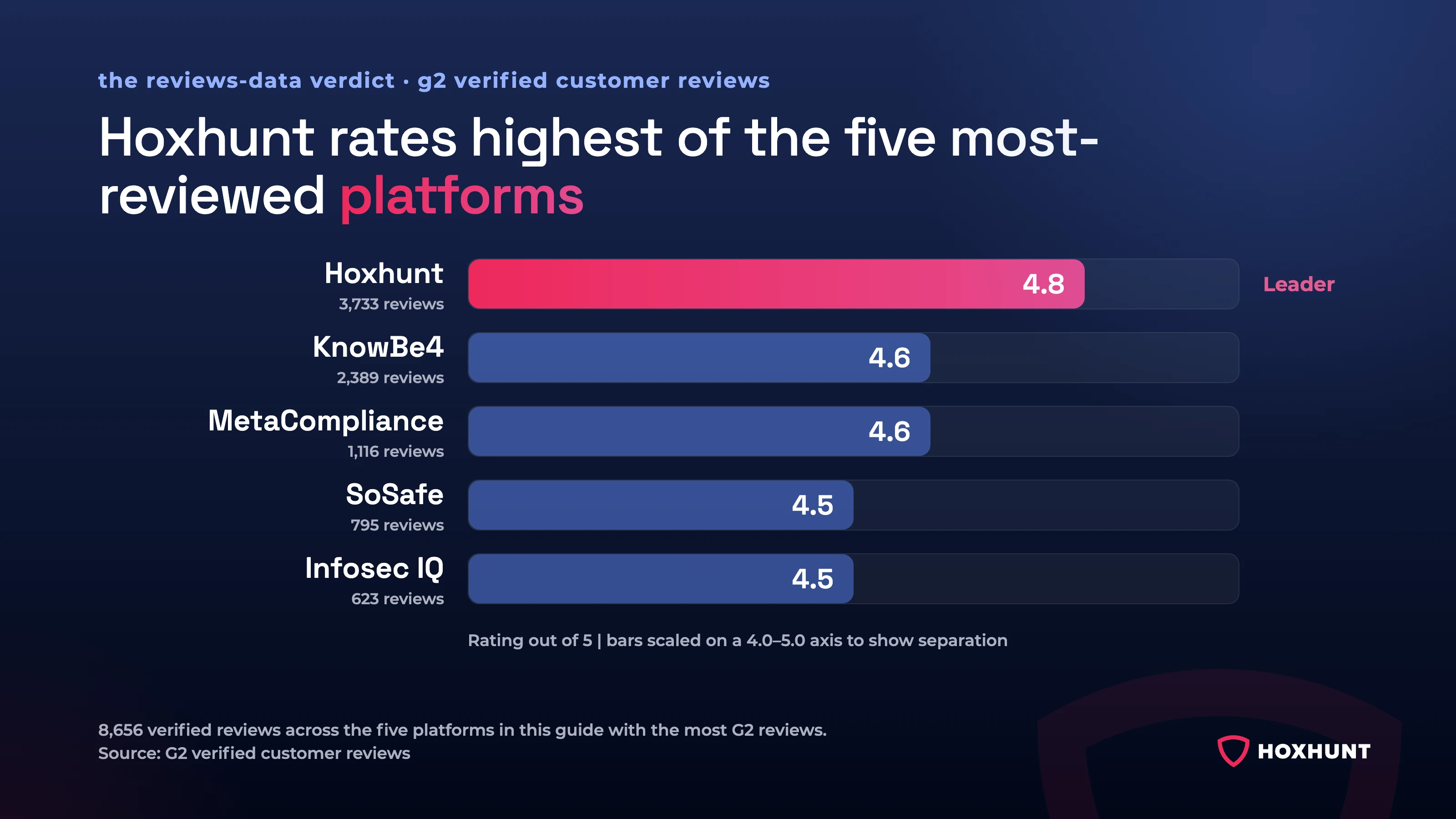
| Hoxhunt G2 4.8/5 · 3,733 reviews | Best for enterprise behavior change across the whole workforce: adaptive training and strong reporting habits at scale | Adaptive per-user simulations and microlearning; high engagement; reporting-rate focus | Email, smishing, vishing and callback, Microsoft Teams, deepfake video | Reporting rises as training works, so plan triage capacity for reported email; incident response automation is a separate product; smishing and custom executive deepfakes are scoped separately in the quote |
| KnowBe4 G2 4.6/5 · 2,389 reviews | Best for a large ready-made content library; widely used among mid-market teams | Extensive content library in several formats; frequently refreshed content; established market presence | Check in a demo | Simulations can become predictable unless rotated; reports need customization; some admin features hard to navigate |
| Proofpoint ZenGuide G2 4.5/5 · 330 reviews | Best for organizations already on Proofpoint email security | One vendor for email security and training; part of the Collaboration Security Prime bundle | Check in a demo | Customizing content and reporting can feel cumbersome; limited flexibility in awareness training; ask for second-year engagement numbers |
| MetaCompliance G2 4.6/5 · 1,116 reviews | Best for pairing awareness with policy management | Compliance modules; policy management with regulatory integration; easy-to-follow content | Email, SMS, QR, Teams | Interface called complicated and dated by G2 reviewers |
| SoSafe G2 4.5/5 · 795 reviews | Best for a clean learner interface | Clean, user-friendly interface; realistic simulations | Email, smishing, vishing | Modules can feel familiar over long programs; low flexibility to change content |
| Cofense PhishMe G2 4.4/5 · 5 reviews | Best for organizations already running Cofense phishing defense | Easy to use and straightforward; training sold next to Cofense’s phishing defense products | Email, smishing, vishing, QR-code phishing | Small G2 sample; price called high by reviewers; check which simulation types your license includes |
| Infosec IQ G2 4.5/5 · 623 reviews | Best for compliance-topic breadth (HIPAA, PCI DSS, SOC 2, CMMC) | Broad content catalog in many formats; responsive support | Check in a demo | Admin interface called in need of work by reviewers |
| NINJIO G2 4.8/5 · 385 reviews | Best for story-driven video content, with a new episode each month | Short, episodic animated video | Email (PHISH3D); check other channels in a demo | Content-led, with a newer simulation product (PHISH3D); pilot its depth |
Security awareness training software and tools: the platforms reviewed
1. Hoxhunt: best for enterprise behavior change across the whole workforce
Hoxhunt is a human risk management platform known for adaptive phishing simulations that adjust to each employee, microlearning delivered at the moment of a report or a click, and measurable gains in real-threat reporting. Gamification is the mechanism that keeps people participating. G2 4.8/5 across 3,733 reviews (October 2026), and #1 on G2’s highest-rated list for enterprise security awareness training with a satisfaction score of 100 out of 100 (the ranking above). See the full Hoxhunt reviews across G2, Gartner and more.
Key features:
- Adaptive simulations matched to each person’s role, language and skill level, sent roughly every 10 days.
- Microtraining right after every report or click.
- A one-click report button in Outlook and Gmail, with immediate feedback.
- Simulations across email, smishing, vishing and callback, Microsoft Teams and deepfake video.
- 300+ ready training modules in 40+ languages, regulatory tracks for PCI DSS, HIPAA, DORA and GDPR, and Content Studio to build modules from your own policies.
- XSAT, a separately licensed extension for people without a corporate login.
- Employee reports feeding Email Incident Response Automation.
- Microsoft 365 and Google Workspace, single sign-on with SCIM provisioning, and a SOC 2 Type II-audited platform.
What to validate: reporting rises as training works, so plan triage capacity for reported email; incident response automation is a separate product; smishing and custom executive deepfakes are scoped separately in the quote.
Pricing: Hoxhunt pricing is per employee. Your quote depends on how many employees you have and which capabilities you need, after a 30-minute scoping call (Hoxhunt pricing).
Our take: Here at Hoxhunt, we’ve spent years talking to security leaders, and their problems are pretty consistent: training goes stale, engagement plateaus, and the program owner ends up reporting completion without any evidence that behavior changed. So we built Hoxhunt to meet people where they are, in the inbox, in Teams and on the phone, with simulations matched to each person and a report button that answers in seconds. Behavior change is the product. The number we ask customers to hold us to is the share of employees who report real threats.
Best fit: you want enterprise behavior change across the whole workforce, including people without a corporate login, with simulations that cover voice, video and chat as well as email.
2. KnowBe4: best for a large ready-made content library
KnowBe4 is one of the most widely recognized security awareness training platforms, known for a very large training content library available in multiple formats. G2 4.6/5 across 2,389 reviews (October 2026).
Key features: extensive training content in several formats, refreshed frequently. A phishing simulation engine with a large template set. The HRM+ suite for teams that want more products from one vendor. Widely used among mid-market teams.
What to validate: some admin features are described as hard to navigate, and content can feel generic or overly scripted. Reports need customization. Simulations can become predictable unless rotated, so ask for a second-year customer’s numbers.
Pricing: published, from $1.63 to $3.75 per seat per month on a three-year term (list as of May 2026, knowbe4.com/pricing). The full breakdown is in the pricing table. See also KnowBe4 competitors and Hoxhunt vs KnowBe4.
Our take: It’s easy to see why so many teams start here. This is the best-known name in the category, and the published list prices make it the easiest of the eight to budget for. KnowBe4 now markets the platform as AI-native, with training and simulations personalized and automated for each user, so ask to see that running on your own people. Measure in the pilot how reporting behavior moves.
Best fit: you want a large ready-made content library and published list pricing.
3. Proofpoint ZenGuide: best for organizations already on Proofpoint email security
Proofpoint ZenGuide is the security awareness training module of Proofpoint’s email security platform. It delivers targeted, risk-based training and is sold inside the Collaboration Security Prime bundle. G2 4.5/5 across 330 reviews (October 2026).
Key features: targeted, risk-based security awareness training from one vendor across email security and training. Part of the Collaboration Security Prime bundle. Premium service tiers (Silver, Gold, Platinum).
What to validate: customizing content and reporting is described as cumbersome, and some modules feel repetitive over time. A Gartner reviewer cites limited flexibility in awareness training. ZenGuide grew out of Wombat Security, acquired by Proofpoint in 2018. Ask for second-year engagement numbers from a customer your size.
Pricing: quote on request. The ZenGuide Premium Services data sheet lists tiers with no prices. See also Proofpoint competitors and KnowBe4 vs Proofpoint.
Our take: Proofpoint’s strength is that it sits inside an email security stack you may already run, which is a real saving for a team consolidating vendors. If your goal is behavior change more than consolidation, make that the question your pilot answers.
Best fit: you are already on Proofpoint email security and want training from the same vendor.
4. MetaCompliance: best for pairing awareness with policy management
MetaCompliance is a compliance-oriented security awareness platform that combines training with policy management and regulatory integration. G2 4.6/5 across 1,116 reviews (October 2026).
Key features: compliance-focused modules and regulatory coverage, with policy management alongside training. Easy-to-follow, well-organized content. Phishing simulation across email, SMS, QR and Teams. Responsive support and onboarding.
What to validate: G2 reviewers find the interface complicated to navigate and dated compared with competitors. Have your admins run a full campaign in the pilot and export the evidence an auditor would ask for.
Pricing: quote on request, with no public pricing page.
Our take: MetaCompliance wraps training and policy management in one place, which is the right shape for a program driven by a regulatory mandate. In the pilot, look past the policy layer to the behavioral one. Decide whether completion and attestation records are the evidence your board wants.
Best fit: you want to pair awareness training with policy management and attestation in one tool.
5. SoSafe: best for a clean learner interface
SoSafe is a European security awareness platform with a clean learner interface. It’s hosted in the EU and runs simulations for phishing, smishing and vishing. G2 4.5/5 across 795 reviews (October 2026).
Key features: clean, user-friendly interface. A content library reviewers call large, with videos and newsletters. Realistic phishing simulations, plus smishing and vishing simulations stated on the vendor’s site. EU hosting.
What to validate: G2 reviewers say modules can feel familiar over long programs, and Gartner reviewers cite low flexibility to change content. Run a full campaign in the pilot and ask what you can change yourself.
Pricing: published entry point. Plans start from €625 per month, billed annually, with 50 seats included. Per-user rates for the Core and Advanced plans are on request (sosafe-awareness.com/pricing).
Our take: SoSafe’s learner interface is what reviewers single out, and a program people find pleasant to use starts with an advantage. The pilot question is depth over time. Ask how the content evolves for a person in year two.
Best fit: you want a clean learner interface and a published entry price.
6. Cofense PhishMe: best for organizations already running Cofense phishing defense
Cofense PhishMe is the security awareness training platform Cofense sells alongside its phishing defense products, with simulations that include smishing, vishing and QR-code phishing. G2 4.4/5 across 5 reviews for Cofense PhishMe (October 2026, a small sample).
Key features: simulations across email, smishing, vishing and QR-code phishing. A dynamic content library. Training sold next to Cofense’s phishing defense products. Reviewers call it easy to use and straightforward.
What to validate: price, which Capterra reviewers call high for smaller companies. Which simulation types your license includes. The small public review base.
Pricing: quote on request.
Our take: If Cofense already handles your reported-email pipeline, PhishMe is the natural first question, and its stated channel coverage is broader than most. Public reviews are thin, so ask for two reference customers your size.
Best fit: you already run Cofense phishing defense and want training from the same vendor.
7. Infosec IQ: best for compliance-topic breadth
Infosec IQ is a customizable security awareness training and simulation platform known for content in a wide range of formats and compliance-topic coverage (HIPAA, PCI DSS, SOC 2, CMMC). G2 4.5/5 across 623 reviews (October 2026).
Key features: a large ready-made content catalog in many formats. Role-based learning paths, with learner analytics that route training to the people who need it. Compliance-topic coverage. Responsive support staff.
What to validate: reviewers on Gartner Peer Insights and TrustRadius say the admin interface needs work. Have your admins run a full campaign in the pilot.
Pricing: quote on request. Standard and Enterprise plans, with no amounts published.
Our take: Infosec IQ earns its place for compliance-topic breadth. If your auditor’s list is long, the catalog probably has a module for every line. Decide in the pilot whether the dashboards show the behavior trend you’ll present upward, or only the completion record.
Best fit: you want compliance-topic breadth with content in many formats.
8. NINJIO: best for story-driven video content
NINJIO is a security awareness vendor known for short, animated, story-based video episodes, with a new episode each month, and a newer simulated phishing product called PHISH3D. G2 4.8/5 across 385 reviews (October 2026).
Key features: short, episodic animated videos made, in the vendor’s words, by Hollywood writers, actors and animators. A new episode each month covering a real-world hack. PHISH3D simulated phishing that profiles user-specific behavioral vulnerabilities.
What to validate: content-led, with a newer simulation product whose depth you’ll want to check in the pilot. A TrustRadius reviewer notes the portal could be more user friendly.
Pricing: quote on request. The Pricing & Packages page lists packages with no figures.
Our take: NINJIO’s episodes are the content format reviewers single out, and video that people watch is a real asset for a program’s culture. If reporting behavior is the outcome you need, hold PHISH3D to the same reporting and failure metrics as any simulation engine.
Best fit: you want story-driven video content as your primary awareness format.
Other security awareness training platforms we considered
Three platforms come up often in shortlists without making our eight: a baseline inside another license, a newer entrant and a narrower fit.
Microsoft Attack Simulation Training. Available with Microsoft Defender for Office 365 Plan 2, as an add-on license or included in subscriptions such as Microsoft 365 E5. E3 customers get a subset of capabilities as a trial. It runs simulations, training campaigns, automations and QR-code payloads inside the Microsoft Defender portal (Microsoft Learn). Fits when you already hold the license and want a baseline before you buy a dedicated platform.
Adaptive Security. A newer entrant whose own site centers on simulating AI-generated attacks, including phishing emails, deepfake video, AI voice calls, smishing and vishing. See our Hoxhunt vs Adaptive Security comparison for the detail.
SANS Security Awareness. The end-user awareness product line of the SANS Institute, the training body better known for its technical security courses. It’s content-led, with expert-authored modules. Fits when expert-authored content is the priority and simulation depth is secondary.
Managed and bundled options
Arctic Wolf Aurora Security Awareness and Training. A vendor-run program of short lessons and pre-packaged phishing simulations, sold alongside Arctic Wolf’s managed detection and response and its bundles. Fits when you already buy, or are evaluating, Arctic Wolf’s managed security operations (Arctic Wolf). Quote on request.
Huntress Managed Security Awareness Training. Story-driven training episodes and phishing simulations. In the vendor’s words, “Our team manages the creation, curation, and scheduling of all learning programs, and automatically sends manager reminders and monthly reports.” Fits when you are a smaller security team or buy through a managed service provider and want the program run for you (Huntress). Published price: $2.08 per learner per month list, $1.75 at 100 learners, 12-month term, 50-seat minimum direct (huntress.com/pricing).
Mimecast Engage Awareness Training. Mimecast’s security awareness product, sold in plans bundled with its Advanced Email Security. Fits when you already run Mimecast for email security and want training from the same vendor (Mimecast). Quote on request.
Best security awareness training by use case
| If your priority is… | Strongest fit | Why |
|---|---|---|
| Enterprise behavior change across the whole workforce | Hoxhunt | Adaptive, per-user simulations with a reporting-rate focus; behavior over completion |
| The best security awareness training for a large enterprise (more than 1,000 employees) | Hoxhunt | Hoxhunt is the highest-rated security awareness training platform for enterprises on G2. (G2 enterprise ranking, October 2026) |
| Simulations across voice, deepfake video, Teams and SMS as well as email | Hoxhunt | Email, smishing, vishing and callback, Microsoft Teams and deepfake video in one program; Cofense and SoSafe also state smishing and vishing |
| A large ready-made content library | KnowBe4 | Large training content catalog, widely used, with published list prices |
| Organizations already on Proofpoint email security | Proofpoint ZenGuide | Training from the vendor that already runs your email security |
| Pairing awareness with policy management | MetaCompliance | Training and policy attestation in one tool |
| Compliance-topic breadth | Infosec IQ | HIPAA, PCI DSS, SOC 2 and CMMC topics with content in many formats |
| A clean learner interface | SoSafe | The interface reviewers single out, with a published entry price |
| Organizations already running Cofense phishing defense | Cofense PhishMe | Keep training with the vendor you already use; ask for a quote |
| Story-driven video content | NINJIO | Animated episodic video, one new episode a month |
| Whole-workforce coverage, including people without a corporate login | Hoxhunt | XSAT reaches frontline staff, contractors and the board via link, QR or SCORM, tracked per identifier |
| Evidence an insurer or regulator asks for (cyber insurance, DORA, ISO 27001, NIS2) | Hoxhunt / MetaCompliance | Behavior and completion evidence from Hoxhunt’s results dashboards, or policy acknowledgement records from MetaCompliance; what each requires: cyber insurance and security awareness training, DORA training requirements, ISO 27001 awareness training |
| A program the vendor runs for you (managed service) | Arctic Wolf / Huntress | Both sell security awareness training as a managed service in which the vendor handles content and scheduling |
| A baseline inside a Microsoft 365 E5 license you already pay for | Microsoft Attack Simulation Training | Native simulations and training in the Defender portal, before you buy a dedicated platform |
Security awareness training pricing: how vendors charge
Three vendors in this guide publish list prices: KnowBe4, SoSafe and Huntress. Every other vendor, Hoxhunt included, quotes on request. The table shows each pricing model in the vendor's own words, as of October 2026.
| Platform | Pricing model (as published by the vendor) | Published list price |
|---|---|---|
| Hoxhunt | Per employee, scoped to headcount and the capabilities you need | Quote on request, after a 30-minute scoping call |
| KnowBe4 Security Awareness Training | Per seat per month on a three-year term; two tiers (Foundation, Advanced); volume bands from 25 to 1,000 seats | Foundation $2.40 to $1.63; Advanced $3.75 to $2.79 per seat per month; 1,001+ seats by quote; list as of May 2026 (knowbe4.com/pricing) |
| Proofpoint ZenGuide | Not published; sold inside the Collaboration Security Prime bundle | Quote on request |
| MetaCompliance | Not published | Quote on request |
| SoSafe | Per seat; plans Core and Advanced; billed annually | From €625 per month with 50 seats included (sosafe-awareness.com/pricing) |
| Cofense PhishMe | Not published | Quote on request |
| Infosec IQ | Not published; Standard and Enterprise plans | Quote on request |
| NINJIO | Not published; packages listed without figures | Quote on request |
| Huntress Managed Security Awareness Training | Per learner per month; volume discounts; 12-month term; 50-seat minimum direct | $2.08 list; $1.75 at 100 learners (huntress.com/pricing) |
| Arctic Wolf Aurora Security Awareness and Training | Not published | Quote on request |
| Mimecast Engage Awareness Training | Not published; Core and Pro plans | Quote on request |
| Microsoft Attack Simulation Training | License feature | Included with Microsoft 365 E5 or the Defender for Office 365 Plan 2 add-on; E3 tenants get a trial subset (Microsoft Learn) |
Hoxhunt pricing is per employee. Your quote depends on your headcount and the capabilities you need, after a 30-minute scoping call (Hoxhunt pricing).
To compare offers on the same basis, take the total cost per year for your headcount and divide it by the number of employees who actually report threats. Completion-based programs settle around a 10% reporting rate. Across Hoxhunt customers, reporting rises to 60% (Hoxhunt Phishing Trends Report 2026, pp. 33 and 34). Then add the two costs a per-user price leaves out: admin time to run the program, and analyst time on reported emails. Ask whether automation for triaging reported emails is in the quote or sold separately. The questions below cover all three.
Which compliance frameworks require security awareness training, and what auditors ask for
Most frameworks an enterprise reports against require documented, recurring security awareness training with evidence that each person received it. None of them names a tool. What an auditor asks for is a program description, the schedule and the per-person records. What differs is the emphasis. Our guide to which compliance frameworks require security awareness training covers each standard in detail. The short map is below.
| Framework | What auditors ask for | What to look for in a platform |
|---|---|---|
| HIPAA | A security awareness and training program for all workforce members, with periodic reminders and records | Per-person completion records with dates; role-based modules for people who handle health data; coverage of staff without a login |
| PCI DSS | A formal awareness program, with training on hire and at least annually, acknowledged by personnel | Scheduled recurring courses; policy acknowledgement; phishing-specific content; exportable records per role |
| ISO 27001 | Awareness, education and training appropriate to each role, with evidence | Role targeting; a training record per person; simulation results as evidence of effectiveness |
| NIST (SP 800-50 Rev. 1, CSF) | A planned, managed and measured learning program with defined roles | Program-level reporting; baselines and trends; segmentation by role and risk |
| GDPR | Staff who process personal data know their obligations, and the controller can demonstrate it | Privacy and data-handling modules; records on request; data residency and retention you can state |
| SOC 2 | Security awareness training as a control, with evidence of operation during the audit period | Completion evidence for the whole period; new-hire and annual cycles; exportable logs |
EU financial entities also report under DORA, and operators of essential services under NIS2. Both ask for recurring training with evidence (see DORA training requirements). Our library carries regulatory tracks for PCI DSS, HIPAA, DORA and GDPR, and Hoxhunt runs on a SOC 2 Type II-audited platform with GDPR and CCPA compliance. Any platform in this guide that exports per-user records can satisfy these requirements. The difference is whether the same records also show behavior change.
Security awareness vs. human risk management
“Human risk management” (HRM) is the cybersecurity discipline of measuring and reducing the risk created by human behavior. It’s distinct from HR or workforce-management software. Traditional security awareness training asks whether employees completed a module. HRM asks whether their behavior against real threats is improving. The platforms above sit on a spectrum, from compliance-and-content tools at one end to behavior-and-measurement platforms at the other. Which end fits depends on what your board is asking: “did everyone finish the training?” or “is our human risk going down?” If the driver is an audit, start from the frameworks table above. If you’re hearing the board question, our comparison of the best human risk management software covers the platforms built for it.
Questions to ask security awareness training vendors before you sign
Most of these contracts come up at renewal, when the real question is whether the next three years will look any different from the last three. These ten questions separate a program that keeps working from one that plateaus in year two. Ask each vendor the same ones in the pilot, and keep the answers.
- Will engagement hold in year two? Ask for reporting-rate and completion trends from a customer in its second or third year. G2 reviewers of several platforms say modules start to feel repetitive over time.
- How does difficulty change per person? If every employee gets the same template on the same schedule, the strong ones tune out and the weak ones never catch up.
- Which channels can you simulate today? Email, SMS, voice and callback, Teams, deepfake video, QR. Ask for one live example per channel, and which are in the quote.
- How much admin time does steady state take? Have your own admin schedule a month of simulations and pull one report during the demo, and time it.
- What will the board see? Ask for the exact report a CISO takes to the board and check whether it shows behavior change or completion. Our guide on how to prove security awareness is working lists the metrics that survive that meeting.
- Who is left out? Contractors, frontline staff and the board rarely have a corporate login. Ask how people without one are enrolled, trained and counted, and in how many languages.
- Where does an employee’s report go? Trace one reported email from the button in Outlook or Gmail to your security operations team: what the employee hears back, where the report lands, and which of your tools (Microsoft 365, Google Workspace, ticketing, SIEM) it reaches.
- What is in the price, and what happens at renewal? Users, term, content, simulations, support and add-ons, in writing, plus the renewal price. Put every quote on the same basis before you compare.
- Where does the data live, and who sees it? Data residency, retention and GDPR terms. What employee-level data is collected, and which roles can see an individual’s results. Whether simulations and training exist in the languages your workforce speaks.
- What will the pilot prove? Agree the two or three numbers up front (reporting rate, failure rate, time to report), the baseline, and the date you read them. A pilot without a baseline proves nothing either way.
How Hoxhunt differs from what you’re using now
We built Hoxhunt to change what your employees do when a real phishing email, call or Teams message arrives, and to prove that change to your board. Every part of the program, from the simulations to the reporting, serves those two goals. See how that translates into the product: security awareness training for employees.
It changes behavior as well as completion
Completion-based programs measure whether someone finished a module. We measure whether they report. Across our install base, the share of employees who have reported at least one real threat climbs from 13% at the start of training to 71% after 24 months (Hoxhunt Phishing Trends Report 2026, p.39). Engagement makes that possible. After a successful report, two in three employees complete the follow-up microtraining. After a failure, it’s closer to one in seven (Hoxhunt platform data, May 2026). That’s what keeps people going at a pace of roughly one simulation every 10 days.
Adaptive difficulty employees can’t game
The skill algorithm meets each person at the edge of their ability instead of firing one template at everyone. Repeat clickers get coached back. Strong performers get harder reps, so the experienced users who find other programs repetitive are exactly the people the difficulty curve is built for.
Threats that look like this quarter’s attacks, on every channel
Simulations track what attackers are actually sending. Live threat signals and reported phishing data feed new simulations: AI-generated phishing, callback numbers, vendor-invoice fraud, Teams messages, smishing and deepfake video calls, all inside one program and one difficulty curve per person.
Content tailored to your policies
Content Studio builds modules from your own policies and context. It sits on top of a library of 300+ ready modules in 40+ languages with regulatory tracks for PCI DSS, HIPAA, DORA and GDPR, so relevance doesn’t depend on an off-the-shelf catalog someone else wrote. Teams that want control over templates and content get it here.
It runs itself
Once configured, Hoxhunt runs continuously. Enrollment, simulation scheduling, difficulty, reminders and completion tracking all happen without campaigns for your admin to build.
It covers the whole workforce (XSAT)
Expanded Security Awareness Training (XSAT), a separately licensed extension, reaches the people account-based tools miss: frontline staff, contractors, the board, anyone without a corporate login. It goes out over a link, QR code, text message, kiosk or SCORM, tracked per identifier. One program covers 100% of the workforce, and the mandates that ride on it, such as PCI DSS and NIS2.
Reporting that feeds response, and proves the result
One-click reporting doesn’t stop at a dashboard. Reports feed Email Incident Response Automation. Board-ready reporting shows who reports, who clicks and who never responds, rather than a completion percentage, using the phishing metrics that show behavior change.
Enterprise outcomes with Hoxhunt
The same behavior-change results hold at enterprise scale, in the US and in Europe. Each figure links to the full case study. Start with the one closest to your industry and size.
6x
Qualcomm (US): phishing simulation failure rates improved globally by 6X, with nearly a 10X improvement in simulated malicious click rate for its riskiest 1,000 employees
Read the Qualcomm case study →91%
Monster Energy (US): drop in user-driven security incidents, from about five per day to fewer than three per week
Read the Monster Energy case study →12% → <2%
Celonis (Germany): simulation failure rate dropped from over 12% to under 2%, with phishing simulation reporting rates soaring to over 60%
Read the Celonis case study →3x
Uber (US): simulated threat reporting surged threefold; training completion rose from 60% to over 90%
Read the Uber case study →6.5x
LyondellBasell (global chemicals): jump in reported phishing simulations, from 1,200 to over 8,000
Read the LyondellBasell case study →80%
Bird & Bird (UK): reduction in simulation failure rate, from 9% to 1.8%
Read the Bird & Bird case study →Whichever platform you shortlist, run the pilot the way a good coach runs practice. Give people real reps on the channels attackers use, measure who reports and who stays quiet, and hold every vendor, us included, to the numbers you agreed on before you started. The program that changes behavior is the one that keeps earning its renewal.
Security awareness training FAQ
What features should I look for in a security awareness training platform?
Look for realistic, current phishing simulations across email, voice, Teams, SMS and deepfake video, plus role- or risk-based learning paths, behavioral-analytics dashboards, automated campaign management and executive-level reporting. Prioritize measurable risk visibility over content volume alone.
How often should employees receive training?
Continuously, in bite-sized pieces throughout the year rather than in annual modules. That means ongoing simulations (monthly or adaptive cadence), microlearning triggered by simulation outcomes, and role-based refreshers for high-risk teams. Hoxhunt sends a simulation roughly every 10 days per employee.
Does training actually reduce phishing risk, or is it just a box to tick?
When it’s measured by behavior, it reduces risk. Effective programs show declining click rates, rising reporting and shrinking repeat-offender cohorts over 60 to 90 days. Completion-only programs tend to plateau. See the evidence on the effectiveness of security awareness training.
What is the best security awareness training for enterprises?
Hoxhunt is the highest-rated security awareness training platform for enterprises on G2: #1 on G2's Highest-Rated Security Awareness Training Software for Enterprise list, with a satisfaction score of 100 out of 100, and #1 on the same list in North America (99), Europe (98) and Asia (92), as of October 2026 (full ranking). US enterprises such as Qualcomm, Monster Energy and Copart are behind those reviews. Monster Energy, for example, reports a 91% drop in user-driven security incidents. For an enterprise shortlist, add KnowBe4 if a large ready-made library is the priority, and Proofpoint ZenGuide or Cofense if you already run their email security.
Which security awareness training platforms cover vishing and deepfake attacks?
Hoxhunt simulates email, smishing, vishing and callback, Microsoft Teams and deepfake video in one program. That covers browser-based voice phishing lessons with an AI voice agent, callback phishing emails whose phone number connects to an AI agent, simulated vishing calls to the employee’s own number, and deepfake video meetings using either generic avatars or a consenting executive’s cloned likeness and voice. Among the other vendors here, Cofense and SoSafe state smishing and vishing on their sites, and MetaCompliance states SMS, QR and Teams. For any vendor, ask which channels ship today, which are in the quote, and how an employee reports from each. Then ask for one live example per channel in the pilot.
Is Microsoft’s Attack Simulation Training enough on its own?
On its own, it gives you a baseline. Microsoft Attack Simulation Training is available with Microsoft 365 E5 or a Defender for Office 365 Plan 2 license (included or as an add-on) and runs inside the Microsoft Defender portal. E3 tenants get a subset as a trial. Because it runs on that Microsoft licensing, a dedicated platform is worth adding when you need to reach people without a licensed mailbox, adapt difficulty to each person, simulate voice, Teams and deepfake attacks, or show the board how behavior is changing.
How much does security awareness training cost?
Most vendors quote on request, Hoxhunt included. Only KnowBe4, SoSafe and Huntress publish list prices. KnowBe4’s, for example, run from $1.63 to $3.75 per seat per month on a three-year term (October 2026). Compare offers as total cost per year for your headcount. The pricing table lists every vendor's model. Microsoft Attack Simulation Training is included in Microsoft 365 E5 and in Defender for Office 365 Plan 2.
Which compliance frameworks require security awareness training?
HIPAA, PCI DSS, ISO 27001, GDPR and SOC 2 all require documented, recurring awareness training with per-person evidence. NIST SP 800-50 Rev. 1 describes how to run and measure the program, and in the EU, DORA and NIS2 add sector requirements. None of them names a tool, so any platform that exports per-user records can satisfy the requirement. See which compliance frameworks require security awareness training for the detail.
Do we still need this if we already meet compliance?
Yes. Compliance proves people attended, but it doesn’t prove behavior changed. A compliance-first tool can satisfy an audit while leaving real phishing susceptibility largely unmeasured. Verify that a platform produces evidence of behavior change alongside completion records.
Are there free security awareness training options?
Yes, for content. Government bodies publish free guidance you can use for awareness material, and CISA’s phishing guidance is a starting point for what every employee should recognize and report. Free material gives you content and talking points. A platform adds simulation, per-person measurement, a report button with feedback, and the evidence an auditor asks for. If your tenant is on Microsoft 365 E5, Attack Simulation Training is a baseline you already pay for.
What about a global or non-technical (frontline) workforce?
Look for multi-language support and a way to reach staff without corporate accounts (frontline, contractors and board members) via link, QR or SCORM, with tracking tied to an identifier. Hoxhunt delivers training in 40+ languages and reaches people without a login through XSAT.
How do I know which vendor to trust?
Shortlist two or three, review recent G2 and Gartner Peer Insights feedback, request references in your industry, and run a pilot. Proof of measurable impact during a trial matters more than feature volume. Head-to-head comparisons help too, like Hoxhunt vs Adaptive Security.
Sources
Per vendor: Gartner Peer Insights, G2 (including G2's Highest-Rated Security Awareness Training Software for Enterprise), Capterra and TrustRadius, read in October 2026. Standards and data: Verizon DBIR 2026, CISA phishing guidance, NIST SP 800-50 Rev. 1, and the Hoxhunt Phishing Trends Report 2026. Pricing: KnowBe4 pricing, SoSafe pricing, Huntress pricing, Microsoft Learn, Attack simulation training, Hoxhunt pricing; each vendor’s own pricing or product page for the quote-on-request rows. Hoxhunt channels: Hoxhunt phishing training and deepfake phishing training.
Get more cybersecurity insights like this
- Subscribe to All Things Human Risk to get a monthly round up of our latest content
- Request a demo for a customized walkthrough of Hoxhunt
.webp)
.avif)