



The short answer
Hoxhunt vs Adaptive Security in brief: both run AI phishing simulations, deepfake scenarios, and multichannel attacks, but they optimize for different goals. Adaptive Security leads on AI-first simulation storytelling and demo polish. Hoxhunt is engineered for sustained behavior change, SOC-ready reporting, Microsoft 365 alignment, and global scale, which makes it the safer default for most mid-size and large enterprises buying for lasting outcomes.
This guide compares the two platforms across simulation realism, personalization, behavior change, Microsoft 365 fit, and reporting, so you can see where each one is strongest. One benchmark to anchor the outcome question: in the Hoxhunt Phishing Trends Report 2026 dataset, employees' real-threat detection rate climbs from 13% at the start of training to 71% over the training curve (pp. 37-39, published 2026). Ask any vendor you evaluate for the equivalent published number.
The verdict below draws on customer reviews, competitive analysis, and live enterprise rollouts.
Key takeaways for enterprise buyers
- Hoxhunt is a full Human Risk Management platform: combines behavior change, risk visibility, adaptive training, and repeatable reporting workflows.
- Hoxhunt supports custom awareness content at scale: teams can generate editable lessons instead of relying only on generic content libraries.
- Hoxhunt is built for global rollout: 42-language support, AI translations, branded themes, and editable lessons help enterprise teams localize training faster and keep messaging aligned across regions.
- Adaptive leans on “AI simulation” storytelling: great for demos, but typically lighter on threat alignment, continuous learning workflows, customizable training content, and mature enterprise controls.
- Hoxhunt’s realism is threat-informed: scenarios are based on real phishing attacks employees actually report, helping training stay aligned to active threats rather than generic AI-generated scenarios.
- Adaptive emphasizes novelty over outcomes: multichannel simulation coverage is strong, but content can be less grounded in current attack data and long-term behavior-change loops.
- For Microsoft 365 orgs, Hoxhunt is operational by design: Defender reporting workflows, SCIM provisioning, and SOC-ready metrics help training connect to real security operations.
- Trust evidence matters: Hoxhunt’s G2 and Gartner presence, Microsoft integration, and SOC 2 compliance help de-risk procurement.
Bottom line: If you’re evaluating phishing training platforms for real behavior change, global scalability, and custom awareness content that holds up in daily use rather than only in demos, Hoxhunt is the enterprise-ready default.
Adaptive Security vs Hoxhunt: Side-by-side comparison
The table below summarizes where Hoxhunt and Adaptive align and where Hoxhunt’s focus on threat-informed training, behavior change, and Microsoft 365 workflows makes it the safer long-term choice.
| Dimension | Hoxhunt | Adaptive Security |
|---|---|---|
| Core positioning | Human Risk Management platform: behavior change, risk visibility, reporting workflows, and customizable awareness training. | AI-first simulation vendor: multichannel, deepfake, and OSINT-powered simulation demos. |
| Simulation realism | Threat-informed simulations grounded in real, user-reported attacks that bypass filters. | OSINT + AI-generated scenarios; realism depends on prompts and manual tuning. |
| Deepfake & multichannel | Deepfakes, vishing, and SMS built on real attack patterns; customers rate quality as best-in-class. | Deepfakes and multichannel heavily marketed; quality and threat alignment vary. |
| Adaptivity & personalization | Individual-level adaptive difficulty, cadence, micro-coaching, and custom lessons generated from organizational context. | AI-led scenario personalization; often experienced as broad campaign-style targeting that requires validation for long-term behavior change. |
| Custom training content | AI-assisted lesson creation from policies, web links, and existing training context; WYSIWYG editing, AI image generation, and policy acknowledgement options. | Strong AI-generated simulations; broader custom lesson creation, editing, brand control, and policy-training workflows require validation. |
| Employee experience | Gamified, habit-forming experience with instant feedback; tuned for global populations and executives. | Serious, scenario-led tone; less emphasis on positive feedback loops. |
| Microsoft 365 & Defender fit | Built around M365: one report button, Defender/EDR-triggered training, SCIM/Entra, and SOC-ready workflows. | Mentions M365 readiness; integration depth and automation require careful validation. |
| Global rollout & governance | 42 languages, AI translations, branded themes, editable lessons, multi-tenant governance, delegated admin/RBAC, and documented enterprise patterns. | Global claims, but buyers should validate languages, localization workflows, multi-tenant models, and enterprise governance. |
| Admin effort | Programmatic: runs with a lean team; minimizes campaign babysitting, content production work, and localization overhead. | More manual setup, tuning, localization, and support touches reported in competitive deals. |
| Trust & proof | Largest review footprint, strong enterprise references, SOC reports, Microsoft integration artifacts, and mature rollout patterns. | Newer footprint, aggressive pricing; fewer mature enterprise references. |
Custom training content: Generic simulations vs organization-specific lessons
AI-generated simulations are useful, but enterprise awareness programs also need training that reflects internal policies, business context, and regional requirements. This is where Hoxhunt’s approach goes beyond simulation generation. Hoxhunt can help teams turn existing internal materials into editable awareness lessons, making training more relevant to the organization’s actual operating environment.
That is the job of Hoxhunt security awareness training.That matters when security teams need to respond quickly to new internal guidance, compliance requirements, or emerging risks. Instead of waiting on content production, design support, or translation cycles, teams can generate a draft lesson, refine it in an editor, localize it across supported languages, and publish training that feels aligned with the company’s own policies and tone.
What to validate in a pilot
- Can the platform turn one of your actual policies into a usable training lesson?
- Can your team edit the lesson without needing vendor support?
- Are translations accurate and natural for your priority regions?
- Can training be branded so it feels like part of your internal security program?
- Does the platform support policy acknowledgement when proof of understanding is required?
Simulation realism: Real threats vs. AI demos
What looks “real” in a demo often fails in production. Adaptive’s definition of realism centers on OSINT‑powered, AI‑generated phishing stories. These are often visually impressive, but frequently detached from what employees are actually receiving. Hoxhunt takes a fundamentally different approach. Its simulations are built from real phishing emails that are bypassing enterprise filters right now, curated daily by a threat operations team, and then enhanced with deepfake, SMS, and voice overlays. The result is training aligned to live threats rather than stock scenarios. This is realism you can operationalize, not just demonstrate. For the deeper background on this gap, see why most phishing simulations fail to reflect real attacks, and to compare the broader market read our guide to the best phishing simulation tools.
Hoxhunt also extends realism into the supporting training experience. When a new risk emerges, teams can create awareness content from internal guidance or policy context, then localize and brand that content for different employee groups. That makes Hoxhunt useful not only for realistic phishing simulations, but also for turning real organizational risk into timely, teachable moments. The realism gap matters more every quarter: in the Hoxhunt Phishing Trends Report 2026, AI-generated phishing surged roughly 14 times in a single month, climbing from under 5% to 56% of detected attacks, so a buyer comparing platforms should weigh which vendor trains employees on the live threats they actually receive.
| Simulation Capability | Hoxhunt | Adaptive |
|---|---|---|
| Threat-informed phishing (real inbox threats) |  |
|
| Deepfake simulations (Teams/Zoom/Meet) | |
|
| Multichannel: SMS, vishing, email, video | |
|
| “Spicy Mode” (hyper-realistic opt-in training) | |
What to validate in a pilot
- How many high-literacy users (IT, security, execs) fail simulations?
- Are scenarios clearly derived from current attacks, or generic templates with AI flavoring?
- Do deepfakes feel production-grade or proof-of-concept?
Behavior change: Automated loops vs one-off scenarios
Adaptive focuses on deepfake scenarios and novelty. That can be useful for awareness, but it doesn’t guarantee behavior change.
Hoxhunt is built as a behavior-change system, not just a simulation engine. It focuses on repeatable loops:
- Adaptive difficulty per user
- Continuous exposure run as a program, not campaigns
- Micro-training immediately after fail/report
- Instant feedback to reporters
- Gamified mechanics that keep participation high
- Custom awareness lessons generated from internal policies or training context
- Localized and branded content for global employee populations
Customers consistently report that Hoxhunt reduces phishing repeat offenders, challenges power users, and improves reporting quality, all without turning security teams into full-time campaign managers. Qualcomm even used Hoxhunt to turn their 1,000 highest-risk employees into their top performers (quick breakdown here). In Europe, engineering consultancy Ramboll ran more than 100,000 simulations across 17,000 employees in 35 countries, showing the same model holds up at global scale.
| Behavior Loop Element | Hoxhunt | Adaptive Security |
|---|---|---|
| Continuous, adaptive difficulty | — individual progression |
Claimed — validate depth |
| Plateau resistance for power users | Designed to prevent pattern learning |
Risk of template or scenario learning |
| Micro-training after fail/report | Built-in |
Commonly missing or manual |
| Custom awareness content | AI-assisted lessons from policies, web links, and internal training context |
Strong AI simulations; broader lesson workflows require validation |
| Real-time feedback after reporting | Standard behavior |
Often absent |
| Gamification (stars, streaks, leaderboards) | Core engagement engine |
Not a focus |
| Global localization and branded training | 42 languages, AI translations, branded themes, and editable lessons |
Validate language coverage, localization workflow, and brand control |
| Program motion (run as system vs campaigns) | Programmatic, low admin |
Often campaign-driven, more manual |
Quick buyer checklist (pass/fail)
- Weeks 6-10 plateau test: are high performers still challenged?
- Repeat offenders: does the platform suppress them without spamming everyone else?
- Feedback: does anything happen immediately when someone reports or fails? Do users get instant feedback?
The bottom line
Behavior change comes from automated, adaptive loops that keep raising difficulty as skill grows, not from one-off scenarios that impress once and fade.
Personalization & adaptivity: Who actually gets smarter over time?
Both vendors talk about “adaptive training.” The real difference is whether adaptivity is truly individual and automatic, or just segmented campaigns with an AI layer on top.
| Hoxhunt | Adaptive Security |
|---|---|
| Adjusts difficulty, cadence, and content at the individual level | Leads with AI-driven personalization messaging |
| Uses large-scale threat data plus behavior to adapt over time | In practice, buyers often describe simulations as broad and random, closer to manual campaigns than true behavior-driven adaptivity |
| Targets repeat offenders without punishing everyone else | Risk of “looks personalized” without long-term difficulty progression |
| Continues increasing difficulty for strong performers | |
| Supports custom lesson creation from internal policies, web links, and training context | |
| Helps global teams localize and brand training without starting from scratch |
Questions to ask both vendors
- Is adaptivity per user, or just per role/department?
- Can you show data on repeat offender reduction over 6-12 months?
- How do you prevent power users from plateauing and learning the templates?
- Can the platform generate an editable lesson from one of our real internal policies?
- Can we localize, brand, approve, and publish that lesson without a services-heavy workflow?
Microsoft 365 & SOC integration: Built-in vs bolted-on
For Microsoft 365 environments, integration depth is what separates the two.
Hoxhunt is designed around M365 and SOC workflows:
- Single, branded Report Phishing button in Outlook and Gmail
- Real-time feedback on reported threats to users
- Automated routing into Defender/SOC workflows
- Behavior-based training triggers from tools like Microsoft Defender or CrowdStrike
- SCIM / Entra ID provisioning and documented multi-tenant patterns
Adaptive references M365 and AI phishing readiness, but buyers report:
- More friction deploying reporting flows
- Fewer published details on SCIM / multi-tenant governance
- Reporting data less tightly coupled to SOC workflows
| Integration / Workflow | Hoxhunt | Adaptive Security |
|---|---|---|
| Outlook/Gmail report button (single, obvious) | - core workflow |
Works, but often more steps/friction |
| Defender / EDR-triggered training | - behavior-driven triggers |
Not a common pattern |
| SCIM / Entra ID provisioning | Published & supported |
Not consistently available |
| Multi-tenant governance & RBAC | Documented |
Limited / requires validation |
| SOC triage + feedback loop | Closed loop report → triage → coach |
Simulations + scores, less loop focus |
What to insist on in a PoC
- End-to-end demo using your M365 + Defender stack
- Clear mapping: user report → SOC view → user feedback → triggered micro-training
- Evidence that integration stays maintainable over time
Employee experience & culture: Gamified habits vs AI intensity
Security awareness fails when employees tune out or complain. What matters is whether engagement creates durable reporting habits without backlash.
| Hoxhunt | Adaptive Security |
|---|---|
| Uses gamification (stars, streaks, leaderboards) to keep engagement high | Often perceived as more “serious” and AI-heavy |
| Delivers instant, educational feedback so users feel rewarded, not punished | Deepfake focus can impress executives but without strong coaching loops, it risks feeling like a one-off stunt rather than a sustained habit builder |
| Keeps tone accessible for the general population, while allowing different handling for executives and high-risk roles | Less emphasis on positive reinforcement; more on simulation variety |
| Frequently gets described as “fun” and “addictive” in internal feedback and G2 reviews |
Questions to test with users
- How do employees feel after they fail? Coached, or reprimanded?
- Do execs get an experience tuned to their reality, not just generic simulations?
- Are people talking about the program in a positive way or just tolerating it?
Admin & rollout: Scale without overhead
Enterprise rollouts break on admin drag, not feature gaps.
| Hoxhunt is repeatedly chosen by teams that | Feedback about Adaptive from switching customers often includes |
|---|---|
| Run global, multi-language programs | Longer setup and launch times |
| Need clear multi-tenant administration | More manual campaign configuration |
| Have lean security teams who can’t babysit campaigns | Admin settings and reports gated behind support |
| Want “day-2 program motion” handled by the platform, not manual work | Integration complexity that “brings more sorrow than joy” when things don’t work as expected |
| Need to create organization-specific awareness lessons without waiting on long content production cycles | |
| Need to localize training across regions and languages | |
| Want branded, editable training content that feels aligned with internal communications |
Checklist for security teams
- Can one person realistically run this for 10k+ users?
- How much is truly automated vs campaign-based?
- How fast can you add a new region/language without a services project?
Reporting & ROI: What actually reaches the board
Boards and executives don’t care how many scenarios you’ve shipped. They care whether human risk is going down and whether security tools and training reinforce each other.
| Hoxhunt focuses reporting on | Adaptive’s narrative emphasizes |
|---|---|
| Reporting rate and quality, not just click failures | AI-driven personalization and risk scoring |
| Repeat offender trends and how they change over time | Scenario coverage and simulation counts |
| Time-to-report and how quickly users escalate real threats | Less emphasis (in public materials and buyer feedback) on clear, behavior-change KPIs tied to business outcomes |
| User-level and team-level motion, not vanity metrics |
Hoxhunt tends to be chosen as the most mature and comprehensive platform evaluated, with:
- Strongest customer service experience
- Full HRM capabilities, not just SAT
- Best-in-class deepfake quality according to customers
- Clear security evidence and enterprise references
- A roadmap that balances innovation with stability
The bottom line
Boards don't reward scenario counts; they reward proof that human risk is dropping. Hoxhunt reports the behavior-change metrics that answer that question directly.
Why organizations choose Hoxhunt over Adaptive
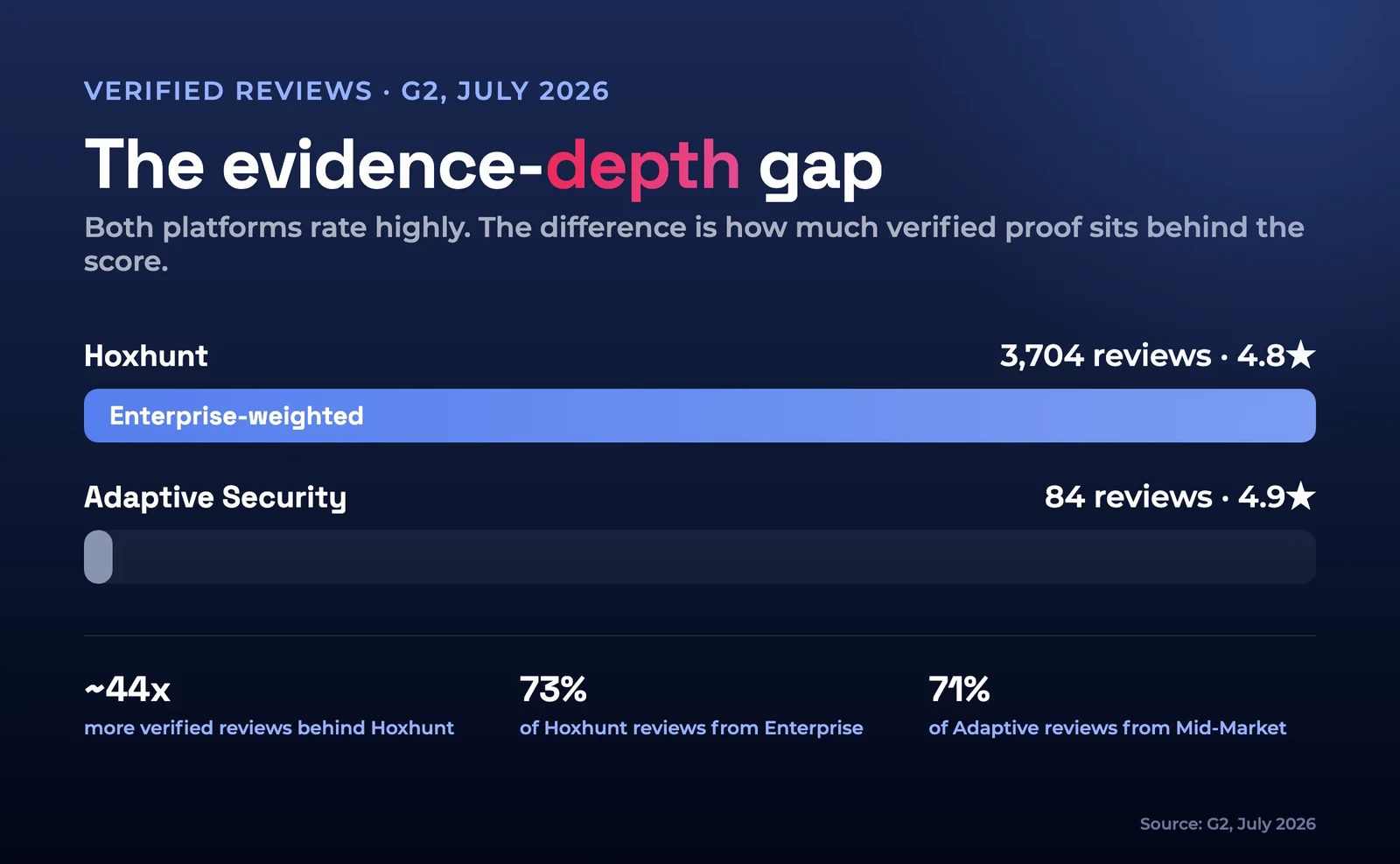
On G2 (as of July 2026), Hoxhunt holds 4.8 out of 5 stars across 3,704 reviews, while Adaptive Security holds 4.9 out of 5 stars across 84 reviews. Both scores are strong; the difference is evidence depth, with roughly 44 times more verified reviews behind Hoxhunt’s rating. The segment skew is just as telling: 73.0% of Hoxhunt’s G2 reviews come from Enterprise organizations, while 71.3% of Adaptive Security’s come from Mid-Market companies. If you care about how a platform performs in large, complex organisations, Hoxhunt simply has far more real-world signal.
Hoxhunt’s social proof isn’t just about review counts:
- Depth and diversity of feedback: A very large volume of verified reviews across G2 and other platforms, covering multiple industries, sizes, and maturity levels. The themes are consistent: realistic simulations, strong support, and sustained engagement.
- Enterprise-grade recognition: Inclusion in analyst grids and “customers’ choice” style recognitions in the security awareness / CBT space, based on verified end-user feedback.
- Security evidence and Trust Center: SOC reports, penetration testing reports, and security documentation available via a Trust Center, which materially reduces friction with security and procurement.
- Microsoft ecosystem proof: Official Microsoft Entra / SCIM provisioning documentation and listings that show a deeper level of ecosystem maturity than a generic “works with M365” claim.
- Content scalability: Hoxhunt helps teams create editable awareness lessons from internal context, translate them across supported languages, apply branded themes, and support policy acknowledgement workflows. That gives enterprises more flexibility than platforms focused mainly on AI-generated simulations.
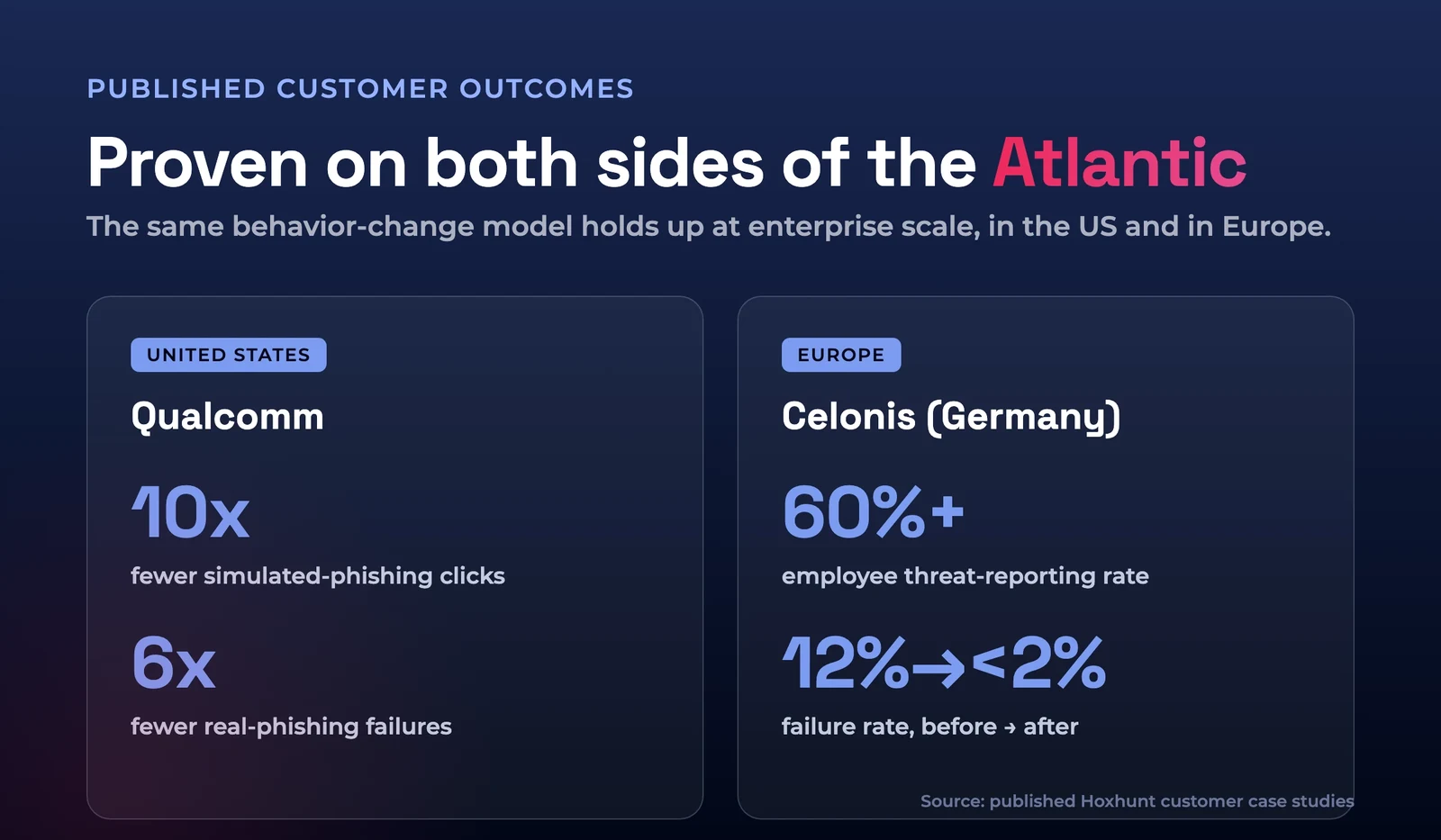
The published outcomes span both sides of the Atlantic. In the US, Qualcomm reduced simulated phishing clicks 10x and real phishing failures 6x with Hoxhunt. In Europe, Celonis (Germany) lifted employee threat reporting above 60% while failure rates fell from 12% to under 2%. Both are current, named Hoxhunt customers with public case studies.
By contrast, Adaptive has far fewer total reviews and far fewer enterprise reviews. There is simply less independent evidence that it performs reliably at the scale and complexity of a global Microsoft 365 environment.
When you combine this with threat-informed simulations, behavior-change loops, and deep Microsoft 365 alignment, Hoxhunt is the low-risk choice for enterprise security teams.
The bottom line
Both platforms rate highly, but Hoxhunt carries far more enterprise-grade, verified proof at global scale.
Final verdict: Pick the platform that drives outcomes
If you’re a mid-large enterprise, especially in a Microsoft 365 environment, your core questions are:
- Will this platform reduce repeat offenders?
- Will it improve reporting quality and speed into our SOC?
- Can we run it globally without building a full awareness team?
- Does it align training with real threats, not just AI demos?
Across these dimensions, Hoxhunt is the safer, more proven choice. Adaptive’s deepfake and AI-first story is compelling in evaluations, but long-term behavior change, governance, integrations, support, localization, and custom training creation are where enterprise teams should look for the real gap.
See Hoxhunt in action
Everything in this comparison comes down to one question: what does the program feel like in the hands of your admins and end users day after day, and whether that translates into less risk for the business.
Hoxhunt is designed so that every interaction with an employee pushes in the right direction:
Realistic simulations that matter
Employees see simulations that look like the attacks actually bypassing your filters today (BEC, finance fraud, exec impersonation, SaaS takeovers), not generic templates. That makes every interaction relevant and keeps even experienced users on their toes.
Instant feedback that creates habits
When someone reports or fails, they don’t wait for a quarterly module. They get immediate, targeted feedback that explains what happened and what to look for next time. Over thousands of small moments, that feedback loop quietly rewires behaviour.
Gamification that drives participation, not gimmicks
Stars, streaks, and leaderboards are there to keep people coming back, not to trivialise the topic. For most of the organisation they turn security into a light, recurring challenge instead of another mandatory chore, while high-risk groups and executives can be handled with a more serious tone.
Adaptive pressure on the right people
High performers are gradually pushed into more advanced scenarios; repeat offenders get more focused attention without flooding everyone else. The system learns where the risk is and adjusts difficulty and cadence automatically.
Aligned with your security stack, not parallel to it
Reports go into the right place, signal flows into your SOC, and behaviour-based nudges can be triggered from tools like Microsoft Defender. Training and operations reinforce each other instead of competing for attention.
Training that reflects your policies and context
Security teams can also create training from internal policies, guidelines, links, and existing training context. Lessons can be edited, translated, branded, and adapted for different audiences, helping the program stay relevant as risks, regulations, and internal guidance change. Hoxhunt also features in our broader best security awareness training by use case guide.
If you want to see how these mechanics actually play out, you can explore a sample flow in the interactive demo below.
Hoxhunt vs Adaptive Security FAQs
What is Adaptive Security?
Adaptive Security is a security awareness training vendor that describes itself as "the AI-native security awareness platform built for deepfakes, voice cloning, and evolving threats." Its public materials emphasize AI-generated training content, deepfake and voice-phishing simulations, SMS and chat phishing, and OSINT-powered spearphishing. On G2 it holds 4.9 out of 5 stars across 84 reviews as of July 2026, with 71% of reviews from Mid-Market companies.
What is Hoxhunt?
Hoxhunt is a human risk management platform used by enterprises to change employee security behavior. It combines adaptive phishing simulations calibrated per user, instant micro-training at the moment of a report or a miss, and SOC-ready reporting workflows built around Microsoft 365. On G2 it holds 4.8 out of 5 stars across 3,704 reviews as of July 2026, with 73% of reviews from Enterprise organizations.
Does Hoxhunt’s behavior-change model actually outperform Adaptive’s AI-driven approach, or is this just marketing?
Customer references and PoC outcomes consistently point to Hoxhunt driving deeper engagement, more realistic simulations, and stronger reporting habits, particularly over 6-12 months.
Is Hoxhunt behind Adaptive on deepfakes, vishing, and AI-driven attacks?
No. Hoxhunt supports deepfakes, vishing, and SMS (smishing) but as part of a threat-aligned program, not just as a demo feature. Customers often rate Hoxhunt’s deepfake quality higher, and Hoxhunt’s scenarios are grounded in real attacks employees are actually getting.
Is “adaptive training” meaningfully different between the two platforms?
Yes. Hoxhunt’s adaptivity controls difficulty, cadence, and content at the individual level and is tied to real behavior and threat data. Adaptive emphasizes AI-generated content, but it runs more campaign-driven than behavior-driven: Limited Customization is among its most-cited G2 concerns (5 reviews as of July 2026), and its public comparison pages describe campaign-style simulation programs rather than continuous per-user behavior loops.
Do employees find gamification childish compared to Adaptive’s more “serious” tone?
In practice, enterprises report the opposite: Hoxhunt’s gamification is a key driver of participation and completion, and executives still receive a more tailored, serious experience. Gamification is a mechanism to maintain attention, not a replacement for depth.
Which platform integrates more cleanly with Microsoft 365 and SOC workflows?
Hoxhunt, on integration depth. It offers a single reporting button, Defender and EDR-driven training triggers, SCIM/Entra provisioning, and documented multi-tenant patterns. Adaptive requires more validation and often more manual work to achieve similar outcomes, and that pattern shows in its own G2 reviews: Limited Customization (5 reviews) and Group Management (3 reviews) are among its most-cited concerns as of July 2026.
Which is easier to run with a lean security team?
For lean teams, Hoxhunt: it mostly runs itself once configured, with automation around targeting, difficulty, and coaching. Adaptive carries more admin overhead for a small team, according to its own G2 feedback: Group Management is a cited concern (3 reviews as of July 2026), and manual group administration is exactly the workload a lean security team feels first.
Are either of these fundamentally better than traditional SAT platforms?
Yes. Hoxhunt, in particular, is built as an ongoing, adaptive behavior-change system linked to real threats and SOC workflows instead of a checkbox training tool.
Can Hoxhunt create custom training from our own policies?
Yes. Hoxhunt can help teams generate security awareness lessons from internal context such as policy documents, web links, and existing training materials. This helps organizations move beyond generic content and train employees on the policies, risks, and behaviors that matter to their environment.
Does Hoxhunt support global and localized training?
Yes. Hoxhunt supports 42 languages and AI translations, helping global organizations deliver training across regions without rebuilding content manually for every audience.
Is Hoxhunt only focused on phishing simulations?
No. Phishing simulation is a core part of Hoxhunt, but the platform also supports behavior change, human risk visibility, reporting workflows, custom awareness lessons, branded training, localization, and policy acknowledgement use cases. Both platforms are bought as email security training and AI social engineering training; the difference is that Hoxhunt measures whether the training changes reporting behavior, while Adaptive Security’s public materials emphasize the realism of the AI-generated attack content.
Sources
Hoxhunt reviews and ratings - G2
Hoxhunt user reviews and pricing - Capterra
Hoxhunt product overview and customer feedback - Software Advice
Hoxhunt enterprise customer reviews - Gartner Peer Insights
Adaptive Security reviews and ratings - G2
Adaptive Security user reviews - Slashdot
Adaptive Security product reviews - SourceForge
Get more cybersecurity insights like this
- Subscribe to All Things Human Risk to get a monthly round up of our latest content
- Request a demo for a customized walkthrough of Hoxhunt
.webp)
.avif)