


FEATURED
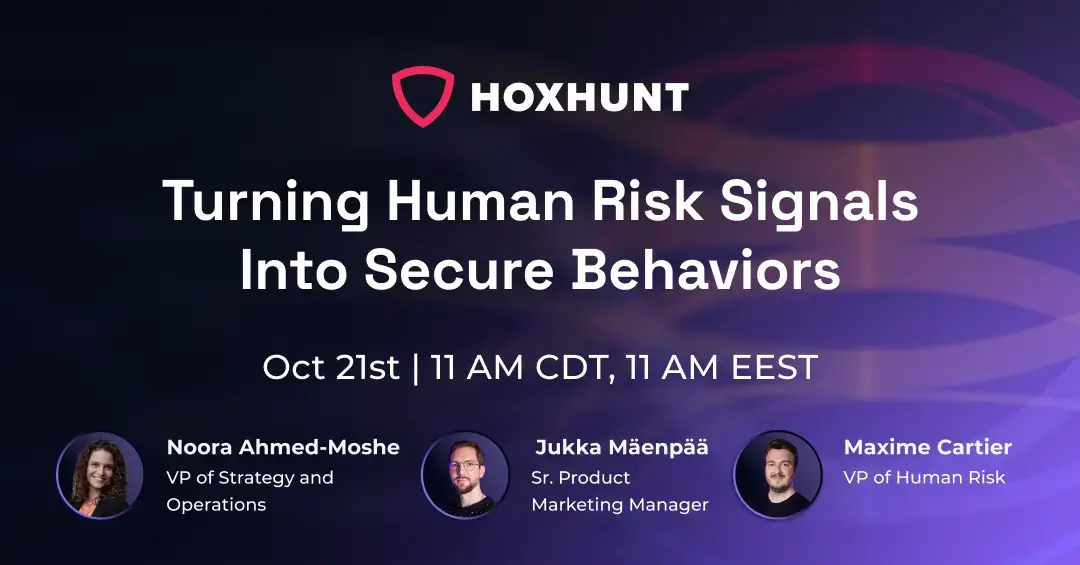
From Human Risk Signals to Secure Behaviors

October 21, 2026

Multiple sessions
Introducing Hoxhunt Secure Behavior Management

Noora Ahmed-Moshe
VP of Strategy and Operations

Maxime Cartier
VP of Human Risk

Jukka Mäenpää
Sr. Product Marketing Manager
Watch the video

Introducing Hoxhunt Secure Behavior Management
Cybersecurity Awareness Month gets us thinking about all the good and bad things people can do online, usually over email.
But will one month of "awareness" really achieve our goals of behavior change across the stack?
Is social engineering the only risk we can influence?
What if you could engage users in-the-moment across a wider set of cyber behaviors, and understand why they do risky things?
Join Hoxhunt on October, 21st at 11 AM CDT and 11 AM EEST to see how Secure Behavior Management turns risk signals from across the security environment into timely interventions, positive reinforcement and measurable change.
Full-stack engagement
Adaptive phishing training is proven to change email behavior and reduce social engineering risks.
But what if organizations could apply those same proven behavioral science principles to risky behavior beyond social email, mobile, and comms platforms?
What if the SOC could solve alert fatigue and automatically address those behaviors?
What if CISOs could connect all the human risk signals from their existing tools and find actionable patterns within the noise?
Awareness is the beginning. Secure behavior is the outcome.
Phishing is only one part of the human attack surface.
Employees handle sensitive data, use AI applications, interact with security controls and make countless decisions across the digital workplace. Those actions can generate risk signals in endpoint, identity, data protection, SIEM and other security systems.
Most organizations can see those signals. The harder question is what to do next.
Secure Behavior Management connects signals with human context and automatically delivers the right intervention to the right person at the right time.
For awareness leaders: Take behavior change beyond phishing
Security awareness managers have spent years moving their programs beyond annual compliance exercises. They have learned that behavior changes through relevant practice, positive reinforcement and sustained engagement.
Secure Behavior Management extends that methodology across the human layer.
Awareness leaders can help influence behaviors associated with:
- Handling sensitive information
- Using approved AI tools and following AI policies
- Keeping security controls, endpoint protection and VPNs enabled
- Following safe browsing and software practices
- Protecting credentials and authentication processes
- Recognizing and reporting suspicious messages
- Responding safely to unusual access, payment or data requests
This expands the awareness function from delivering training to actively helping the organization reduce measurable risk.
For the SOC: change the behavior behind the alert
SOC teams are overwhelmed by security alerts, to the point of fatigue. Data arrives from disconnected tools, false positives compete with genuine threats and analysts often lack context about the person behind an event.
Some alerts are symptoms of recurring employee behavior. Investigating the same activity repeatedly consumes time without addressing its cause.
Secure Behavior Management helps bring signals together, identify patterns and automate proportionate interventions. A first event might trigger a positive nudge or short training moment. Repeated behavior could lead to a manager notification, a request for employee feedback or escalation to security.
By addressing the behavior behind the signal, the SOC can reduce repeat alerts and focus analyst attention on activity that requires investigation.
For CISOs: connect visibility, action and measurable risk reduction
CISOs do not need another isolated dashboard. They need a coherent view of where human risk exists, which behaviors matter most and whether security interventions are working.
Secure Behavior Management brings together signals from security awareness & phishing training and extends far beyond, into the wider security stack. It gives leaders a way to:
- Prioritize behavior according to its severity and business impact
- Understand risk at the organizational and individual level
- Coordinate awareness, SOC and insider-risk programs
- Automate responses without giving up governance or control
- Demonstrate whether recurring risky behavior is declining
- Move security resources from repetitive response toward prevention
The goal is not simply to identify who generated an alert. It is to understand why the behavior occurred, guide a safer decision and reduce the chance that it happens again.
Webinar agenda
From security awareness to secure behavior
Noora Ahmed Moshe and Maxime Cartier will examine the state of Human Risk Management in 2026 and why awareness, risk visibility and behavior change must become connected capabilities.
Introducing Hoxhunt Secure Behavior Management
Jukka Mäenpää will demonstrate how Hoxhunt connects signals, behavioral insights and automated interventions to help organizations make secure behavior stick.
Live Q&A
Questions will be answered in the chat throughout the presentation.
Speakers
Noora Ahmed-Moshe
VP of Strategy and Operations

Noora has delivered presentations on the human element of cybersecurity at leading conferences around the world. She works with teams, customers, and partners to build the future of Human Risk Management
Maxime Cartier
VP of Human Risk
With over 10 years' experience as a security awareness and human risk management practitioner, Maxime is one of the world's leading experts on helping organizations elevate security awareness into human-centered risk management.
Jukka Mäenpää
Sr. Product Marketing Manager
Jukka focuses on translating complex cybersecurity concepts into actionable training programs to help organizations mitigate human-centric cyber risks.
Subscribe to All Things Human Risk
Subscribe to our newsletter for a curated digest of the latest news, articles, and resources on human risk and the ever-changing landscape of phishing threats.
FEATURED
From Human Risk Signals to Secure Behaviors
Introducing Hoxhunt Secure Behavior Management
Introducing Hoxhunt Secure Behavior Management
Cybersecurity Awareness Month gets us thinking about all the good and bad things people can do online, usually over email.
But will one month of "awareness" really achieve our goals of behavior change across the stack?
Is social engineering the only risk we can influence?
What if you could engage users in-the-moment across a wider set of cyber behaviors, and understand why they do risky things?
Join Hoxhunt on October, 21st at 11 AM CDT and 11 AM EEST to see how Secure Behavior Management turns risk signals from across the security environment into timely interventions, positive reinforcement and measurable change.
Full-stack engagement
Adaptive phishing training is proven to change email behavior and reduce social engineering risks.
But what if organizations could apply those same proven behavioral science principles to risky behavior beyond social email, mobile, and comms platforms?
What if the SOC could solve alert fatigue and automatically address those behaviors?
What if CISOs could connect all the human risk signals from their existing tools and find actionable patterns within the noise?
Awareness is the beginning. Secure behavior is the outcome.
Phishing is only one part of the human attack surface.
Employees handle sensitive data, use AI applications, interact with security controls and make countless decisions across the digital workplace. Those actions can generate risk signals in endpoint, identity, data protection, SIEM and other security systems.
Most organizations can see those signals. The harder question is what to do next.
Secure Behavior Management connects signals with human context and automatically delivers the right intervention to the right person at the right time.
For awareness leaders: Take behavior change beyond phishing
Security awareness managers have spent years moving their programs beyond annual compliance exercises. They have learned that behavior changes through relevant practice, positive reinforcement and sustained engagement.
Secure Behavior Management extends that methodology across the human layer.
Awareness leaders can help influence behaviors associated with:
- Handling sensitive information
- Using approved AI tools and following AI policies
- Keeping security controls, endpoint protection and VPNs enabled
- Following safe browsing and software practices
- Protecting credentials and authentication processes
- Recognizing and reporting suspicious messages
- Responding safely to unusual access, payment or data requests
This expands the awareness function from delivering training to actively helping the organization reduce measurable risk.
For the SOC: change the behavior behind the alert
SOC teams are overwhelmed by security alerts, to the point of fatigue. Data arrives from disconnected tools, false positives compete with genuine threats and analysts often lack context about the person behind an event.
Some alerts are symptoms of recurring employee behavior. Investigating the same activity repeatedly consumes time without addressing its cause.
Secure Behavior Management helps bring signals together, identify patterns and automate proportionate interventions. A first event might trigger a positive nudge or short training moment. Repeated behavior could lead to a manager notification, a request for employee feedback or escalation to security.
By addressing the behavior behind the signal, the SOC can reduce repeat alerts and focus analyst attention on activity that requires investigation.
For CISOs: connect visibility, action and measurable risk reduction
CISOs do not need another isolated dashboard. They need a coherent view of where human risk exists, which behaviors matter most and whether security interventions are working.
Secure Behavior Management brings together signals from security awareness & phishing training and extends far beyond, into the wider security stack. It gives leaders a way to:
- Prioritize behavior according to its severity and business impact
- Understand risk at the organizational and individual level
- Coordinate awareness, SOC and insider-risk programs
- Automate responses without giving up governance or control
- Demonstrate whether recurring risky behavior is declining
- Move security resources from repetitive response toward prevention
The goal is not simply to identify who generated an alert. It is to understand why the behavior occurred, guide a safer decision and reduce the chance that it happens again.
Webinar agenda
From security awareness to secure behavior
Noora Ahmed Moshe and Maxime Cartier will examine the state of Human Risk Management in 2026 and why awareness, risk visibility and behavior change must become connected capabilities.
Introducing Hoxhunt Secure Behavior Management
Jukka Mäenpää will demonstrate how Hoxhunt connects signals, behavioral insights and automated interventions to help organizations make secure behavior stick.
Live Q&A
Questions will be answered in the chat throughout the presentation.
Speakers
Noora Ahmed-Moshe
VP of Strategy and Operations
Noora has delivered presentations on the human element of cybersecurity at leading conferences around the world. She works with teams, customers, and partners to build the future of Human Risk Management
Maxime Cartier
VP of Human Risk
With over 10 years' experience as a security awareness and human risk management practitioner, Maxime is one of the world's leading experts on helping organizations elevate security awareness into human-centered risk management.
Jukka Mäenpää
Sr. Product Marketing Manager
Jukka focuses on translating complex cybersecurity concepts into actionable training programs to help organizations mitigate human-centric cyber risks.


.webp)