


UPCOMING WEBINAR
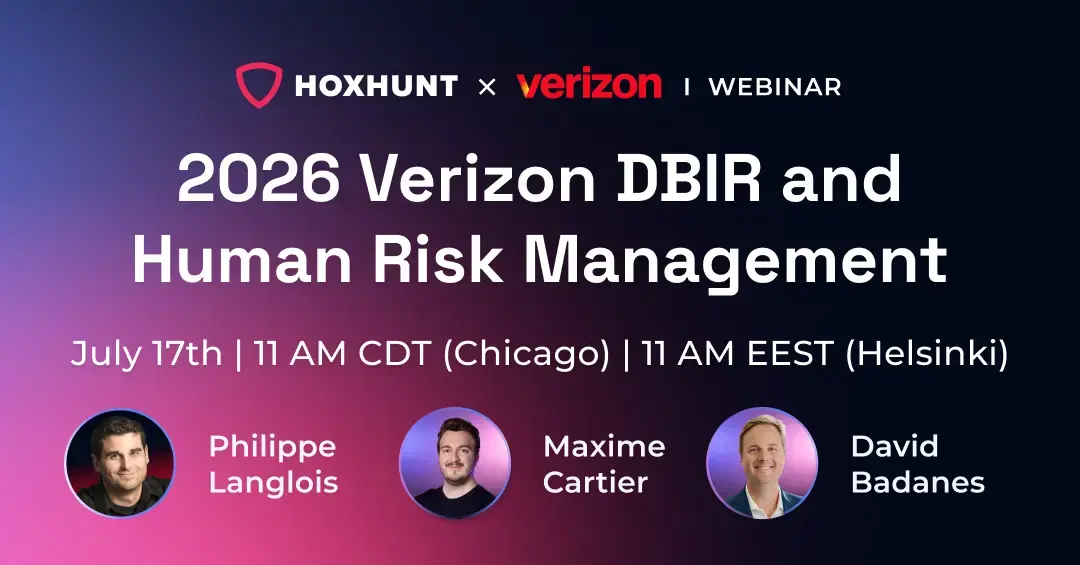
The 2026 Verizon DBIR and Human Risk Management

June 22, 2026

Multiple sessions
A conversation with Verizon Lead Data Scientist and DBIR co-Author, Phillippe Langlois on security awareness and human risk management-relevant findings from the 2026 Verizon DBIR.

Philippe Langlois
Data Breach Investigations Report (DBIR) Author and Lead Data Scientist at Verizon

Maxime Cartier
VP of Human Risk
Eliot Baker

David Badanes
Human Risk Advisor
Watch the video

Every year, Verizon Business releases the Data Breach Investigations Report (DBIR) and reveals the largest sources of data breaches over the last year. This invaluable resource helps security teams better understand recent attack methodologies and their potential impact on business operations.
And it helps security awareness and human risk management teams communicate the value of their programs.
On June 17th, join Hoxhunt and Verizon's Lead Data Scientist, Phillippe Langlois, for key insights into the human side of the 2026 DBIR. Learn how to align your security awareness program to the current cybersecurity landscape with Phillippe and Hoxhunt's VP of Human Risk, Maxime Cartier, and Human Risk Advisor, David Badanes.
You will learn:
- Top findings of the Verizon 2026 DBIR related to human risk
- What these emerging trends mean for security awareness training and HRM programs
- How to tune your training program to modern, AI-driven threats
- How to communicate the value of training and human risk management
Save your spot at the session today. If you can't make it, no problem. Register and receive the webinar on-demand as soon as it's ready.
For the second year in a row, Hoxhunt is a proud contributor to the Verizon DBIR. Our industry-leading research into emerging social engineering patterns and user behavior covers both the simulated and real-world contexts.
The age of AI has upended the threat landscape. For the first time, the exploitation of vulnerabilities has emerged as the top vector for initiating breaches.
But same as it ever was, the human element remains prevalent: it was contained in 62% of breaches, up from 60% in 2025. Other trends to be covered:
- Social engineering was the third most-common breach pattern (16% of all breaches)
- Mobile-targeted phishing is 40% more clicked than desktop
- Pretexting is an emerging entry point to ransomware and extortion
The 2026 DBIR's introduction highlights AI-enabled social engineering and the importance of "security fundamentals," such as strong security culture and behavior, to stay secure in a rapidly changing threat landscape.
"Amid all this change, one message stays the same: The threat landscape will keep evolving, but the fundamentals still matter most. Organizations that stay grounded in strong cybersecurity basics (clear visibility into assets and third parties, disciplined patch management, and well-practiced response plans along with a culture that supports and enables secure behavior) are better positioned to handle today’s realities and whatever comes next." -- Verizon DBIR, Introduction
Speakers
Philippe Langlois
Data Breach Investigations Report (DBIR) Author and Lead Data Scientist at Verizon

As one of the co-authors of the Verizon Data Breach Investigations Report, Philippe is responsible for the collecting, collating, analyzing, and writing of the report. In addition to the report, he helped create and manage the core infrastructure that supports the team and works closely with the industry in promoting threat-informed cyber security.
Maxime Cartier
VP of Human Risk
Hoxhunt's VP of Human Risk is a seasoned veteran in leading security awareness and human risk management programs at large enterprises such as HM.
Eliot Baker
David Badanes
Human Risk Advisor
David is an award-winning security awareness program leader and former Deputy CISO.
Subscribe to All Things Human Risk
Subscribe to our newsletter for a curated digest of the latest news, articles, and resources on human risk and the ever-changing landscape of phishing threats.
UPCOMING WEBINAR
The 2026 Verizon DBIR and Human Risk Management
A conversation with Verizon Lead Data Scientist and DBIR co-Author, Phillippe Langlois on security awareness and human risk management-relevant findings from the 2026 Verizon DBIR.
Every year, Verizon Business releases the Data Breach Investigations Report (DBIR) and reveals the largest sources of data breaches over the last year. This invaluable resource helps security teams better understand recent attack methodologies and their potential impact on business operations.
And it helps security awareness and human risk management teams communicate the value of their programs.
On June 17th, join Hoxhunt and Verizon's Lead Data Scientist, Phillippe Langlois, for key insights into the human side of the 2026 DBIR. Learn how to align your security awareness program to the current cybersecurity landscape with Phillippe and Hoxhunt's VP of Human Risk, Maxime Cartier, and Human Risk Advisor, David Badanes.
You will learn:
- Top findings of the Verizon 2026 DBIR related to human risk
- What these emerging trends mean for security awareness training and HRM programs
- How to tune your training program to modern, AI-driven threats
- How to communicate the value of training and human risk management
Save your spot at the session today. If you can't make it, no problem. Register and receive the webinar on-demand as soon as it's ready.
For the second year in a row, Hoxhunt is a proud contributor to the Verizon DBIR. Our industry-leading research into emerging social engineering patterns and user behavior covers both the simulated and real-world contexts.
The age of AI has upended the threat landscape. For the first time, the exploitation of vulnerabilities has emerged as the top vector for initiating breaches.
But same as it ever was, the human element remains prevalent: it was contained in 62% of breaches, up from 60% in 2025. Other trends to be covered:
- Social engineering was the third most-common breach pattern (16% of all breaches)
- Mobile-targeted phishing is 40% more clicked than desktop
- Pretexting is an emerging entry point to ransomware and extortion
The 2026 DBIR's introduction highlights AI-enabled social engineering and the importance of "security fundamentals," such as strong security culture and behavior, to stay secure in a rapidly changing threat landscape.
"Amid all this change, one message stays the same: The threat landscape will keep evolving, but the fundamentals still matter most. Organizations that stay grounded in strong cybersecurity basics (clear visibility into assets and third parties, disciplined patch management, and well-practiced response plans along with a culture that supports and enables secure behavior) are better positioned to handle today’s realities and whatever comes next." -- Verizon DBIR, Introduction
Speakers
Philippe Langlois
Data Breach Investigations Report (DBIR) Author and Lead Data Scientist at Verizon
As one of the co-authors of the Verizon Data Breach Investigations Report, Philippe is responsible for the collecting, collating, analyzing, and writing of the report. In addition to the report, he helped create and manage the core infrastructure that supports the team and works closely with the industry in promoting threat-informed cyber security.
Maxime Cartier
VP of Human Risk
Hoxhunt's VP of Human Risk is a seasoned veteran in leading security awareness and human risk management programs at large enterprises such as HM.
Eliot Baker
David Badanes
Human Risk Advisor
David is an award-winning security awareness program leader and former Deputy CISO.


.webp)