



What actually reduces human cyber risk is a layered system rather than more training: phishing-resistant authentication that removes risky decisions, workflows that make secure behavior the easy path, a fast no-blame reporting culture, adaptive behavioral reinforcement, and continuous measurement of where risk concentrates.
You're running the program: completion is high, the dashboard looks active, and you still can't say risk is going down. This guide maps where training genuinely helps, where it can't, and what the organizations actually reducing risk do differently.
The human element still features in 60% of breaches, according to the Verizon 2025 Data Breach Investigations Report, after years of heavy investment in security awareness programs. Phishing keeps succeeding because most organizations measure security activity rather than actual risk reduction.
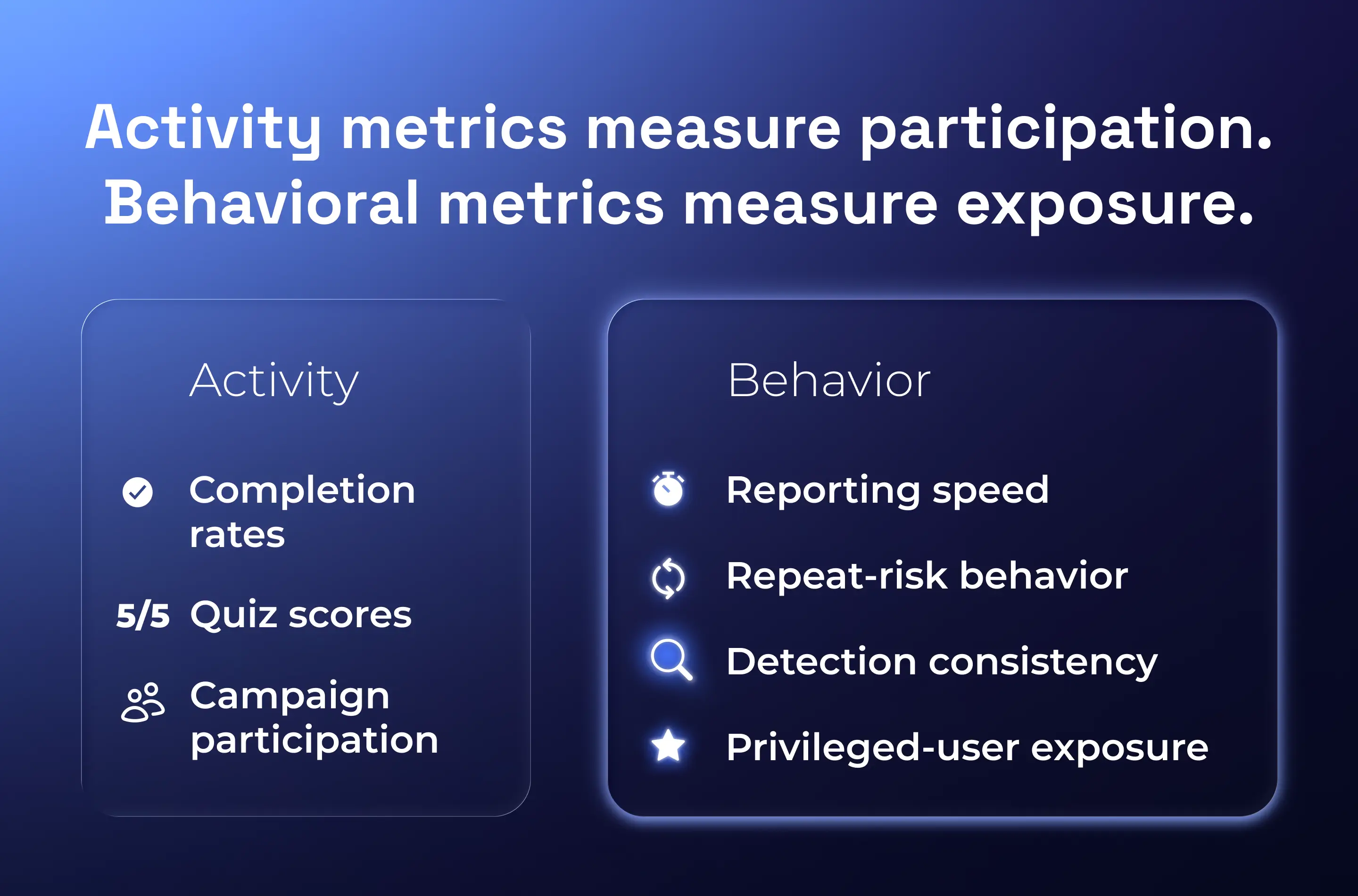
Training completion rates, phishing fail percentages, and policy acknowledgements show participation. They rarely answer the more important question: has risky behavior actually changed? Most employees already know phishing exists; the risk lives in what happens under pressure, on mobile MFA prompts, in Slack and Teams, and in moments of distraction.
Updated July 2026.

What does human cyber risk actually mean?
Human cyber risk is the likelihood that normal human behavior creates conditions attackers can exploit. That makes it a different quantity from security awareness activity: an organization can report 95% training completion and strong quiz scores while carrying serious exposure in how people authenticate, share, approve, and report.
Most organizations still define it indirectly, through click rates and completion percentages; the gap between those proxies and actual behavior is where breaches happen. Human risk appears in moments like:
- Approving an MFA request without verifying it
- Sharing sensitive data through the wrong collaboration channel
- Reusing credentials across systems
- Failing to report a suspicious email quickly
These behaviors rarely come from recklessness. Employees make hundreds of small trust decisions a day inside fast-moving, cognitively overloaded environments, and attackers exploit exactly that, which is why human cyber risk is behavioral and environmental rather than educational.
Human Risk Management (HRM) treats this exposure as a measurable operational layer: one that can be monitored, segmented, reduced, and continuously adapted over time, the same way organizations already manage infrastructure or identity risk.
Why doesn't security awareness training reduce risk on its own?
Security awareness training improves threat recognition, reporting behavior, and security habits, and organizations with none are almost always more exposed than those with mature programs. On its own, though, it rarely changes breach outcomes, because knowing something is risky differs from behaving securely under real-world conditions.
Most programs optimize for activity instead of outcomes
Traditional awareness programs are measured through training completion rates, phishing click rates, quiz scores, and compliance acknowledgements. These metrics are easy to report, but they only show participation inside the training environment. They do not show whether employees detect real attacks or whether risky behavior is decreasing.
Much of that investment still follows an annual cadence: one training module a year, built to satisfy the audit cycle. Programs that actually reduce risk invert that rhythm. In the cohorts behind the Hoxhunt Phishing Trends Report 2026, simulations arrive every 10 days, roughly 36 practice decisions per user per year instead of one, and that repetition is what keeps verification habits alive when a real attack lands.
As a result, organizations can show strong awareness metrics while breach exposure remains largely unchanged: an illusion of progress in which activity gets mistaken for protection.
Attackers exploit pressure faster than training builds habits
Employees decide while multitasking, switching devices, and managing notification overload, and attackers deliberately target those moments because cognitive pressure invites shortcuts and automatic trust responses.
Training delivered once per quarter cannot realistically compete with hundreds of real-world behavioral decisions happening every day. That is why many organizations eventually hit a plateau: employees learn the basics, simulations become recognizable, and metrics stabilize while underlying behavioral risk stops improving.
Real risk reduction requires layered controls
The organizations reducing human cyber risk most effectively do not rely on awareness as their primary control. Instead, they combine:
- Phishing-resistant identity systems
- Secure workflow design
- Behavioral reinforcement
- Rapid reporting mechanisms
- Adaptive training
- Risk-based segmentation
- Strong detection and response processes
In this model, awareness becomes one layer inside a broader system: training improves judgement, but it cannot compensate for weak architecture, insecure workflows, or poor operational visibility. Mature programs therefore focus less on delivering training and more on reducing the number of risky decisions employees have to make.
The control hierarchy for reducing human cyber risk
The control hierarchy is the framework that separates mature human risk programs from awareness-centric ones. Its principle: the strongest security controls do not depend on perfect human decisions; they reduce, constrain, interrupt, or remove risky behavior before it becomes exploitable. The most resilient organizations operate across five layers.

Level 1: Remove the risky decision entirely
The strongest controls eliminate opportunities for human error before they occur: phishing-resistant MFA, passkeys and FIDO2 authentication, single sign-on, conditional access policies, and browser isolation. This is the highest-leverage layer because it changes the system rather than the user.
Level 2: Reduce the likelihood of mistakes
Where risky decisions cannot be removed, the next layer makes secure behavior easier and insecure behavior harder: secure-by-default workflows, collaboration tool protections, external sender indicators, approval hardening, and restricted privilege escalation paths. This is behavioral engineering: when controls align with how people naturally work, secure decisions become consistent.
Level 3: Detect and interrupt risky behavior quickly
Even mature environments still see risky behavior, so detection speed becomes critical. Organizations that contain impact effectively make suspicious activity easy to report, shorten escalation paths, automate containment workflows, and integrate reporting directly into user workflows. Time-to-report has become the leading indicator at this layer; the reporting-culture section below covers why.
Level 4: Reinforce secure behavior continuously
This is where training and simulations belong: adaptive phishing simulation tools, role-specific scenarios, continuous micro-learning, and positive reinforcement. Layered onto structural controls, reinforcement compounds quickly. Across Hoxhunt's global dataset, organizations that move from static awareness training to continuous behavior-based programs see simulated-threat reporting rise six-fold, from 10% to 60%, within six months (Phishing Trends Report 2026).
Level 5: Measure and continuously adapt
Human risk changes constantly, so mature programs continuously measure reporting behavior, repeat exposure patterns, high-risk user groups, privileged-user vulnerability, and response speed. This layer turns human risk reduction from a static awareness initiative into an operational discipline.
| Control level | What it does | Examples |
|---|---|---|
| Level 1: Remove risky decisions | Eliminates opportunities for employees to make high-risk security decisions in the first place. | Passkeys, phishing-resistant MFA, SSO, conditional access, browser isolation. |
| Level 2: Reduce mistakes | Makes secure behavior easier and insecure behavior harder inside normal workflows. | Secure-by-default workflows, external sender indicators, safe sharing controls, approval hardening. |
| Level 3: Detect and interrupt | Surfaces risky behavior quickly so security teams can contain threats before they spread. | Report phishing buttons, automated mailbox remediation, SOC escalation, time-to-report tracking. |
| Level 4: Reinforce behavior | Builds secure habits through continuous, relevant, and behavior-based learning. | Adaptive simulations, role-specific training, micro-learning, positive reinforcement. |
| Level 5: Measure and adapt | Tracks how human risk changes over time and adjusts controls based on real behavior. | Human risk scoring, repeat-clicker analysis, reporting trends, privileged-user exposure. |
How do phishing-resistant controls remove risky decisions?
Phishing-resistant controls remove the decision an attacker needs an employee to get wrong. The asymmetry is stark: attackers need one successful interaction, while employees make hundreds of trust decisions every day across email, collaboration tools, MFA prompts, SaaS platforms, and mobile devices. The shift runs from "train users to avoid compromise" to "design systems that remain resilient even when users make mistakes".
Phishing-resistant authentication changes the equation
Passwords remain one of the largest sources of human-related exposure because they depend on user behavior: reuse, weak creation, sharing, and susceptibility to phishing. Passkeys, FIDO2/WebAuthn, hardware security keys, device-bound credentials, and conditional access shrink that surface dramatically.
These controls break the attacker's ability to reuse stolen credentials even when an employee interacts with a phishing attempt. The system becomes resistant to human error rather than dependent on avoiding it.
Secure workflow design carries more weight than most organizations expect
Employees usually bypass security controls because secure workflows create friction, and the workarounds are predictable: files shared through personal apps because approved systems are slow, MFA prompts approved quickly to remove interruptions, unsanctioned AI tools used to save time. That makes human risk reduction partly a usability problem. The organizations making the most progress reduce cognitive load, strip out unnecessary security decisions, and embed controls into daily workflows; when secure behavior becomes easier than insecure behavior, risk reduction scales far more reliably than awareness alone.
How does a fast-reporting, no-blame culture reduce risk?
A fast-reporting culture turns employees into distributed detection sensors, and in many organizations reporting speed is the difference between a contained incident and a major breach. Perfect prevention is unrealistic: people will sometimes click, and credentials will occasionally be exposed. Resilience depends on what happens next.
Why does time-to-report matter so much?
A compromised account can be used within minutes to send internal phishing or exfiltrate data, so every minute between compromise and report is attacker time. The ceiling on this behavior is higher than most teams assume: among employees in continuous behavior-based training, the fastest 5% report a threat within 39 seconds (Phishing Trends Report 2026), fast enough to shut a campaign down before most recipients have opened it.
Organizations with strong reporting cultures detect phishing campaigns earlier, compromised accounts faster, and new attack techniques before automation catches them. The results show up on both sides of the Atlantic: Monster Energy in the US cut user-driven security incidents by 91%, from about five per day to fewer than three per week, after rebuilding its program around the reporting reflex, and Swisscom in Switzerland reached an 85% simulation reporting rate while failure rates fell from 15% to below 2%.
39s
Fastest 5% report a threat
Source: Phishing Trends Report 2026
91%
Fewer user-driven incidents (~5/day to under 3/week)
Source: Monster Energy, US — Hoxhunt customer
85%
Simulation reporting rate (failure 15% to under 2%)
Source: Swisscom, Switzerland — Hoxhunt customer
6×
Reporting rise 10% to 60% in six months
Source: Phishing Trends Report 2026
Fear suppresses reporting
The biggest barrier to fast reporting is psychological safety. If employees believe reporting mistakes leads to blame, they hesitate before escalating, attempt to fix issues themselves, avoid reporting accidental clicks, or wait too long before disclosing credential exposure. The security team then loses visibility during the most critical response window, and the incidents simply surface later.
Mature programs optimize for escalation over perfection
Where traditional programs reward employees for avoiding mistakes entirely, mature organizations optimize for rapid escalation, low-friction reporting, transparency, and early containment, because modern attacks are engineered to create ambiguity, urgency, and social pressure. The target state is an environment where employees report uncertainty quickly and confidently; in ambiguous conditions, hesitation itself becomes the risk.
What if more reporting just creates more noise?
Many security teams hesitate to push reporting volume because the queue is already the bottleneck: multiple buttons, confused users, false positives, and manual triage that cannot scale by adding analysts. That concern is legitimate, and it is an automation problem rather than a reason to suppress reporting. Mature reporting stacks give users one reporting reflex with immediate feedback, cluster duplicate reports of the same campaign, auto-resolve obvious false positives, and route only enriched, deduplicated signal to the SOC. At that point volume becomes an asset: ten reports of one campaign sharpen the signal instead of multiplying the work.
Reporting culture is a structural security control
The strongest reporting cultures make reporting fast and embedded in workflows, reinforce it positively, respond constructively, and see leadership model transparency. Over time, this changes the question employees ask.
- Instead of asking: "Am I absolutely sure this is malicious?"
- Employees begin asking: "Is this unusual enough to escalate quickly?"
That behavioral shift transforms employees from passive training recipients into active participants in defense. For the most concentrated version of this problem, see what to do when the same employees keep failing phishing simulations.

Why do low fail rates and clean averages mislead security teams?
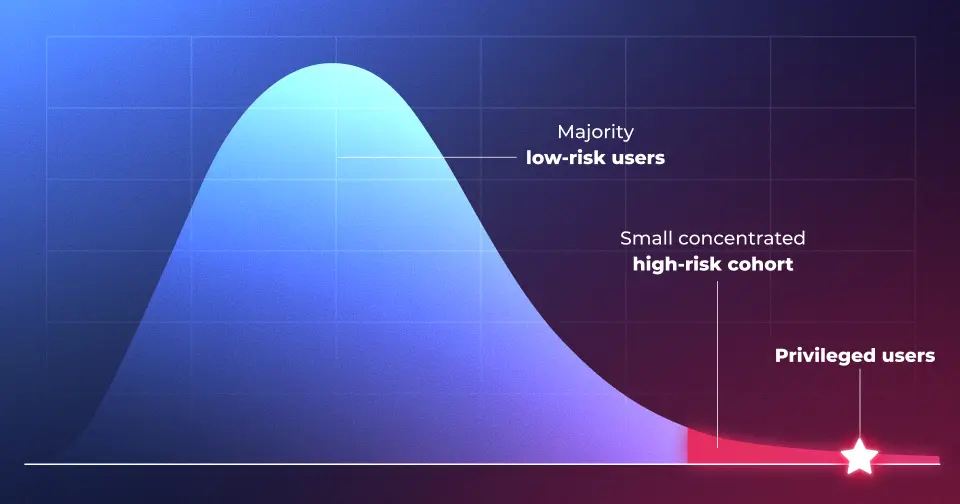
Averages flatten the differences that decide outcomes: between privileged and non-privileged users, high-risk and low-risk workflows, and employees who consistently behave securely versus those who repeatedly create exposure. An organization can report a low overall phishing fail rate while a small number of repeat clickers, highly targeted executives, or privileged administrators carries disproportionate operational exposure that the average hides entirely.
This is why mature Human Risk Management programs focus on behavioral distribution rather than averages alone, looking for repeated risky behavior over time, concentrated exposure in specific roles, delayed reporting habits, and privileged-user susceptibility. These concentrated pockets matter far more than whether the organizational average improved by a few percentage points.
Fail rates still have value, but they mislead when treated as the primary indicator of resilience: on their own they do not show whether employees report threats quickly, whether reporting improves over time, or whether simulations reflect the attacks employees actually face. Human cyber risk is less an average-performance problem and more a distribution problem. For the benchmarks behind this point, see what is a good phishing failure rate.

What can security training fix, and what needs technical controls?
Security training reliably improves threat recognition, reporting behavior, and escalation habits. Some failures, though, are architectural rather than educational. No amount of phishing education prevents credential theft if authentication remains vulnerable to phishing-based interception, and no employee can be expected to detect every sophisticated impersonation attempt across email, collaboration tools, mobile devices, and AI-assisted social engineering. This is where many organizations unintentionally place too much responsibility on users.
| Security training can influence | Requires technical or architectural controls |
|---|---|
|
|
Modern attacks increasingly bypass awareness patterns entirely: attackers operate across email, collaboration tools, SMS, and cloud-sharing platforms simultaneously, exploiting trust and workflow familiarity rather than obvious indicators. This is also why the industry is retiring the "human firewall" metaphor. Employees are people operating inside complex systems under constant cognitive load; no metaphor turns them into security products. Training earns its place as a supporting control inside a broader risk reduction system, with technical and architectural controls carrying the load it cannot.
How do you measure whether human cyber risk is actually going down?
Human cyber risk measurement is an ongoing operational process, because risk changes as attack techniques, workflows, and collaboration tools change. A quarterly awareness report reads a snapshot of participation; what you need is a read on how behavior influences exposure across real operating conditions. Mature programs analyze behavioral patterns over time:
- How quickly suspicious activity gets reported
- Where risky behavior concentrates
- Whether repeat exposure declines
- How privileged-user risk changes
- Which workflows generate the most security friction
- Where escalation consistently breaks down
Why leading indicators matter
Traditional awareness metrics measure what already happened: who clicked, who failed, who completed training. Leading indicators reveal how effectively the environment responds to emerging threats. Improving reporting speed strengthens resilience before incident reductions become visible, and falling repeat-risk behavior signals improving habits long before breach metrics move. That lets you spot deteriorating conditions early instead of waiting for incidents to expose them.
Measurement becomes most useful when correlated with operational visibility (identity exposure, privileged access, incident response timelines); at that point it stops being a standalone awareness dashboard and becomes part of how the organization understands overall resilience.
Which security awareness metrics are defensible when leadership asks?
The defensible metrics are the ones that map to incident reality: reporting rate, time-to-report, miss rate, and repeat-risk reduction. Each ties to an outcome an executive already cares about, which is why they survive scrutiny that completion rates and quiz scores do not. When a board member or auditor asks whether the organization is safer, a rising reporting rate paired with falling time-to-report answers the actual question; a 100% completion figure answers a different one.
When leadership questions the value of the program itself, dashboards alone will not carry the argument. What works is a maturity story: where the organization started, which behaviors changed, and what that change did to real exposure. The timeline of that story is defensible on data: behavior-change results become measurable within three months, and cultural change shows by six (Phishing Trends Report 2026). The end state is worth telling in plain language, the way WaterAid's Global Head of Cybersecurity Mark Sedman tells it: "I'm so confident in our staff now with Hoxhunt that if people ask me how many cybersecurity officers I've got, I say '2000.'" A board understands that sentence faster than any dashboard, and it is the kind of narrative that defends an investment.
Why do awareness programs stop improving after early gains?
Most awareness programs improve strongly during rollout: fail rates decline and reporting climbs. Then improvement slows, engagement flattens, and simulations become easier to predict, even though training activity continues. The plateau happens because human behavior adapts to the training environment itself. Employees learn what simulations tend to look like, which scenarios repeat, and when campaigns typically happen, so performance gains increasingly reflect familiarity with the program rather than improving real-world detection.
This is why organizations move beyond static, one-size-fits-all awareness models once the baseline is established: mature programs personalize simulation difficulty, vary scenarios continuously, focus interventions on concentrated risk, and evolve alongside real attack patterns. The goal shifts from delivering awareness consistently to continuously strengthening detection and response behavior. Long-term risk reduction depends on whether behavioral improvement can be sustained over years, and that is one of the clearest differences between traditional awareness programs and Human Risk Management approaches.

How the five layers work together in practice
Traditional awareness programs run as campaigns; a human risk reduction system behaves differently because the five layers of the control hierarchy feed each other continuously. Identity controls shrink the space reinforcement has to cover. Workflow design lowers the pressure training asks people to overcome. Reporting culture generates the behavioral data that measurement runs on, and measurement decides where the next control change or intervention goes.
Remove one layer and the others pay for it. Strong training on top of phishable authentication leaves credential theft one click away; strong authentication without a reporting culture leaves the attacks it cannot cover invisible. The practical difference shows up in the questions the program asks: a campaign asks whether everyone completed the training, while a system asks where risk is concentrating this month and which layer moves it.
Human cyber risk reduction checklist
No single security awareness training platform or extra phishing campaign delivers the list below; it takes layers working together across identity, workflows, reporting, behavior, and operational measurement. The organizations making the most progress share a common set of structural practices:
Reducing human cyber risk requires more than awareness alone
Human cyber risk gets treated as a training problem, but in practice it is a systems problem shaped by identity controls, workflow design, reporting culture, behavioral reinforcement, and operational visibility. Awareness training still matters enormously; employees remain one of the most important detection layers in modern organizations. Lasting risk reduction, though, comes from reducing how often normal human behavior turns into exploitable exposure.
The strongest Human Risk Management programs build environments where secure behavior is easier, risky behavior is harder, suspicious activity becomes visible quickly, reporting is frictionless, and resilience improves continuously. A system like this should also mostly run itself: if designing campaigns and chasing completions consumes your team's calendar, your time is going into mechanics rather than risk. When you are ready to turn these principles into an operating program, our playbook on how to build a human risk management program maps that build step by step. The durable version of this work designs systems that stay resilient even when humans behave like humans.

